Division With Remainders Worksheets for 4th Grade
Download PDF worksheetAnswer key (PDF)Worksheet + answer key (2 pages)
Prints on one US Letter page; the answer key is a separate page. Print at 100% / "Actual size" on US Letter paper. Free for personal and classroom use. Version 1 of 10. Choose another version.
Skill: Dividing two-digit numbers by one-digit numbers with a remainder
Teaching tips and what to try next
Students should know their multiplication and division facts well before this, since every problem sits next to a fact. In word problems the remainder has to be interpreted: sometimes it means one more box is needed, sometimes it is simply left over, so talk through a story for a few answers. When this feels easy, move on to Long Division With One-Digit Divisors or real-life practice in Division Word Problems.
10 versions, each with its own answer key
Same skill and layout, a fresh set of problems in every version, so children can keep practicing without repeating a page. Problems are not repeated between versions unless a skill has only a small number of possible problems (for example, the addition facts within 10).
- Version 1: Sheet · Key · Both
- Version 2: Sheet · Key · Both
- Version 3: Sheet · Key · Both
- Version 4: Sheet · Key · Both
- Version 5: Sheet · Key · Both
- Version 6: Sheet · Key · Both
- Version 7: Sheet · Key · Both
- Version 8: Sheet · Key · Both
- Version 9: Sheet · Key · Both
- Version 10: Sheet · Key · Both
Download all 10 versions (one PDF)All 10 answer keys (PDF)
Make a new one
Want more practice? Make a brand-new Division With Remainders sheet with fresh problems and its matching answer key, created right in your browser.
Related worksheets
About this worksheet
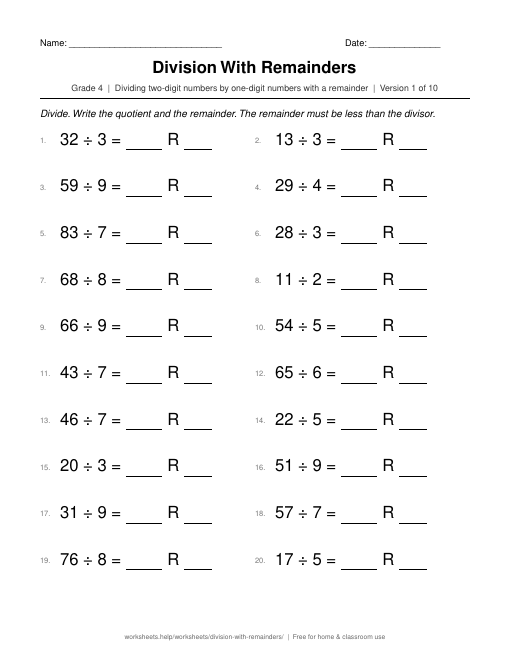
Not every number divides evenly. When 23 cookies are shared by 4 friends, each friend gets 5 cookies and 3 are left over. That leftover amount is the remainder. This fourth-grade worksheet gives twenty division problems that all have a remainder, so students practice finding both parts of the answer before they move on to long division.
Every problem divides a two-digit number by a one-digit divisor from 2 to 9, such as 47 ÷ 6. Quotients go from 2 to 11, and every remainder is at least 1 and always less than the divisor. Students write the quotient on the first line and the remainder after the R. Because each problem is close to a multiplication fact students already know, the sheet also builds fact fluency. The ten versions each use new problems.
How to use it: teach a short routine. Ask, "What is the biggest multiple of the divisor that is not more than the number?" For 47 ÷ 6, that is 42, because 6 × 7 = 42. The quotient is 7, and 47 – 42 = 5 is the remainder. Students can check their work by multiplying the quotient by the divisor and adding the remainder; the result should be the number they started with. If a remainder is equal to or bigger than the divisor, the quotient is too small. Counters or drawings of equal groups help students who are just starting.
The answer key lists every quotient and remainder. This worksheet supports Common Core standard 4.NBT.B.6. When students are ready, move on to our Long Division With One-Digit Divisors worksheet. For fact review, try our Division Facts 6-9 worksheet.