Dividing Multiples of 10, 100 and 1,000 Worksheets for 4th Grade
Download PDF worksheetAnswer key (PDF)Worksheet + answer key (2 pages)
Prints on one US Letter page; the answer key is a separate page. Print at 100% / "Actual size" on US Letter paper. Free for personal and classroom use. Version 1 of 10. Choose another version.
Skill: Dividing multiples of 10, 100 and 1,000 by a one-digit number using basic facts
Teaching tips and what to try next
For fourth graders who know their division facts and can name 3,000 as 3 thousands or 30 hundreds. A place-value chart with digit cards makes the shifted zeros visible as your child moves them. Try the reverse skill in Multiplying by Multiples of 10, then move to uneven dividends in Long Division With One-Digit Divisors.
10 versions, each with its own answer key
Same skill and layout, a fresh set of problems in every version, so children can keep practicing without repeating a page. Problems are not repeated between versions unless a skill has only a small number of possible problems (for example, the addition facts within 10).
- Version 1: Sheet · Key · Both
- Version 2: Sheet · Key · Both
- Version 3: Sheet · Key · Both
- Version 4: Sheet · Key · Both
- Version 5: Sheet · Key · Both
- Version 6: Sheet · Key · Both
- Version 7: Sheet · Key · Both
- Version 8: Sheet · Key · Both
- Version 9: Sheet · Key · Both
- Version 10: Sheet · Key · Both
Download all 10 versions (one PDF)All 10 answer keys (PDF)
Make a new one
Want more practice? Make a brand-new Dividing Multiples of 10, 100 and 1,000 sheet with fresh problems and its matching answer key, created right in your browser.
Related worksheets
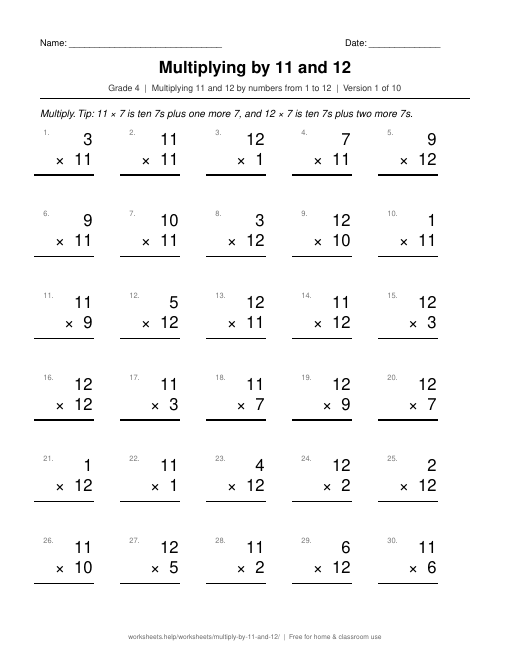 Multiplying by 11 and 12
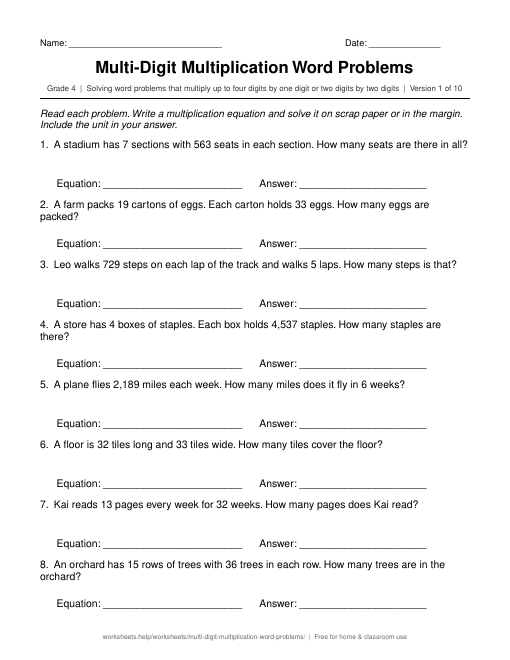 Multi-Digit Multiplication Word Problems
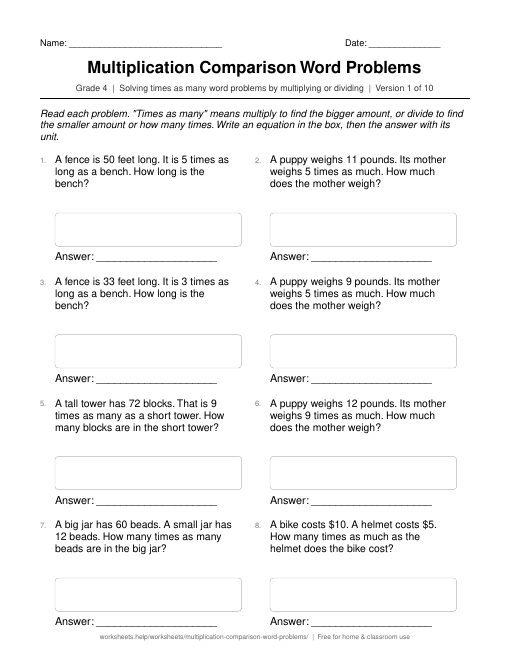 Multiplication Comparison Word Problems
About this worksheet
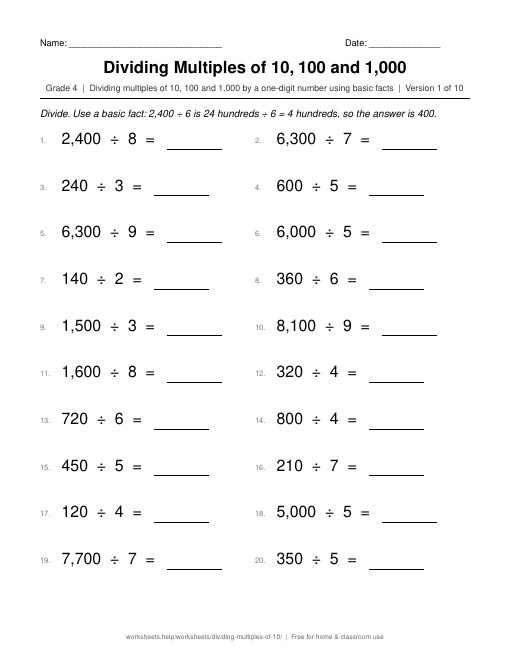
A fourth grader who knows that 24 ÷ 6 = 4 can also solve 240 ÷ 6 and 2,400 ÷ 6 in their head. The trick is to think in place value: 2,400 is 24 hundreds, and 24 hundreds split into 6 equal groups is 4 hundreds. This fourth-grade worksheet gives twenty division problems built on that idea.
Each dividend is a basic multiplication fact scaled up by 10, 100 or 1,000, such as 350 ÷ 7 or 4,800 ÷ 8. The divisors are always one-digit numbers from 2 to 9, and every dividend has at most four digits, which matches what fourth graders are expected to divide. Watch for problems that hide a zero inside the basic fact, as in 4,000 ÷ 8, where the fact is 40 ÷ 8 = 5. Those are the problems where children most often drop a zero. Each of the ten versions has new problems and its own answer key.
How to use it: ask your child to say each dividend as tens, hundreds or thousands first. For 5,600 ÷ 7, they would say "56 hundreds divided by 7 is 8 hundreds," and then write 800. Covering the extra zeros with a finger can help find the basic fact. Afterward, check by multiplying: 7 × 800 should give back 5,600. If an answer is off by a zero, the place-value sentence usually shows why.
The answer key shows every quotient. To practice the matching multiplication skill, try our Multiplying by Multiples of 10 worksheet. For dividends that do not divide evenly, try our Long Division With One-Digit Divisors worksheet.