Interpreting Remainders in Word Problems Worksheets for 4th Grade
Download PDF worksheetAnswer key (PDF)Worksheet + answer key (2 pages)
Prints on one US Letter page; the answer key is a separate page. Print at 100% / "Actual size" on US Letter paper. Free for personal and classroom use. Version 1 of 10. Choose another version.
Skill: Deciding what a remainder means in a division story
Teaching tips and what to try next
Best for fourth graders who can already find a quotient and remainder, as in Division With Remainders. Ask your child to say the answer in a full sentence with the unit; hearing "9 vans" next to "4 students without a seat" makes the choice obvious. For longer stories, move on to Multistep Word Problems (Grade 4).
10 versions, each with its own answer key
Same skill and layout, a fresh set of problems in every version, so children can keep practicing without repeating a page. Problems are not repeated between versions unless a skill has only a small number of possible problems (for example, the addition facts within 10).
- Version 1: Sheet · Key · Both
- Version 2: Sheet · Key · Both
- Version 3: Sheet · Key · Both
- Version 4: Sheet · Key · Both
- Version 5: Sheet · Key · Both
- Version 6: Sheet · Key · Both
- Version 7: Sheet · Key · Both
- Version 8: Sheet · Key · Both
- Version 9: Sheet · Key · Both
- Version 10: Sheet · Key · Both
Download all 10 versions (one PDF)All 10 answer keys (PDF)
Make a new one
Want more practice? Make a brand-new Interpreting Remainders in Word Problems sheet with fresh problems and its matching answer key, created right in your browser.
Related worksheets
About this worksheet
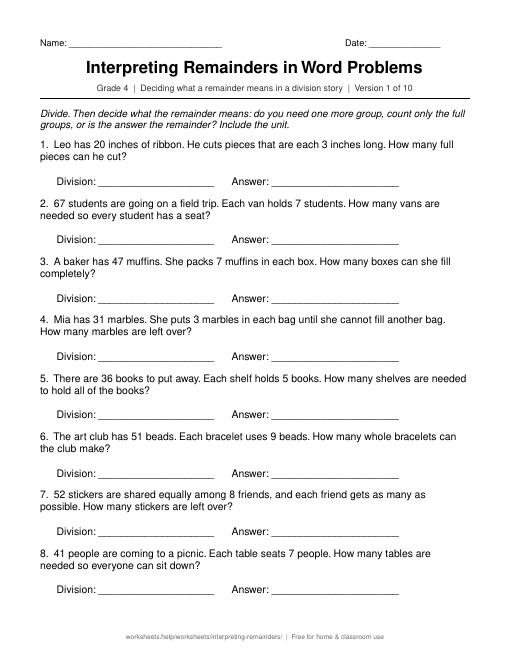
In fourth grade, children learn that the remainder in a division problem can mean different things in different stories. Sometimes it means one more group is needed, sometimes it is ignored, and sometimes it is the answer. This fourth-grade worksheet gives eight short division stories that each leave a remainder.
Three stories ask how many vans, shelves, or tables are needed, so the answer is one more than the quotient. Three stories ask how many full boxes, pieces, or bracelets can be made, so the remainder is dropped. Two stories ask how many are left over, so the remainder itself is the answer. The stories are mixed, so children must read each question carefully. Divisors are 3 to 9, and the totals are small enough to divide mentally or with a quick sketch. Each of the ten versions has new numbers and its own answer key.
How to use it: ask your child to solve the division first and write it with an R, such as 67 ÷ 7 = 9 R4. Then reread the question and ask, "What do the 4 extra ones mean here?" Drawing the vans or boxes helps: if four students are left without a seat, one more van is needed. Talk about the difference between the words full and needed in the questions.
The answer key shows the division with its remainder and the final answer with the unit. For more practice dividing with remainders, try our Division With Remainders worksheet. For stories without remainders, try our Division Word Problems worksheet.