Converting Metric Units With Decimals Worksheets for 5th Grade
Download PDF worksheetAnswer key (PDF)Worksheet + answer key (2 pages)
Prints on one US Letter page; the answer key is a separate page. Print at 100% / "Actual size" on US Letter paper. Free for personal and classroom use. Version 1 of 10. Choose another version.
Skill: Converting metric length, mass and capacity units, including decimals
Teaching tips and what to try next
Metric units are based on powers of 10, so converting means multiplying or dividing by 10, 100 or 1,000. A place value chart labeled with units (km, m, cm) helps. Review Multiplying and Dividing by Powers of 10, or compare with customary units in Converting Units of Measurement.
10 versions, each with its own answer key
Same skill and layout, a fresh set of problems in every version, so children can keep practicing without repeating a page. Problems are not repeated between versions unless a skill has only a small number of possible problems (for example, the addition facts within 10).
- Version 1: Sheet · Key · Both
- Version 2: Sheet · Key · Both
- Version 3: Sheet · Key · Both
- Version 4: Sheet · Key · Both
- Version 5: Sheet · Key · Both
- Version 6: Sheet · Key · Both
- Version 7: Sheet · Key · Both
- Version 8: Sheet · Key · Both
- Version 9: Sheet · Key · Both
- Version 10: Sheet · Key · Both
Download all 10 versions (one PDF)All 10 answer keys (PDF)
Make a new one
Want more practice? Make a brand-new Converting Metric Units With Decimals sheet with fresh problems and its matching answer key, created right in your browser.
Related worksheets
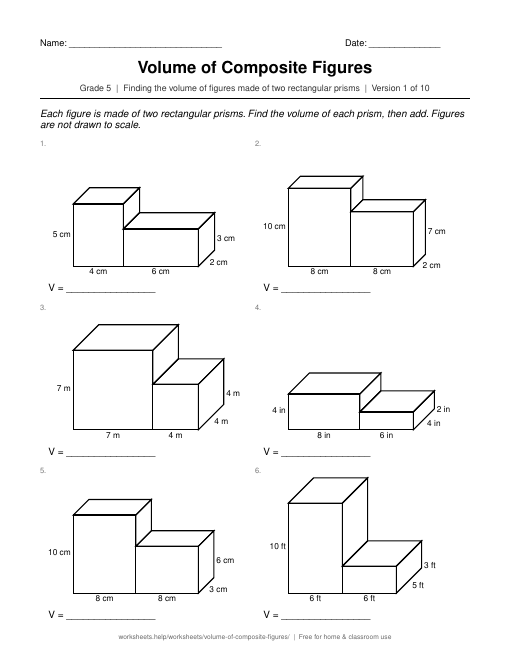 Volume of Composite Figures
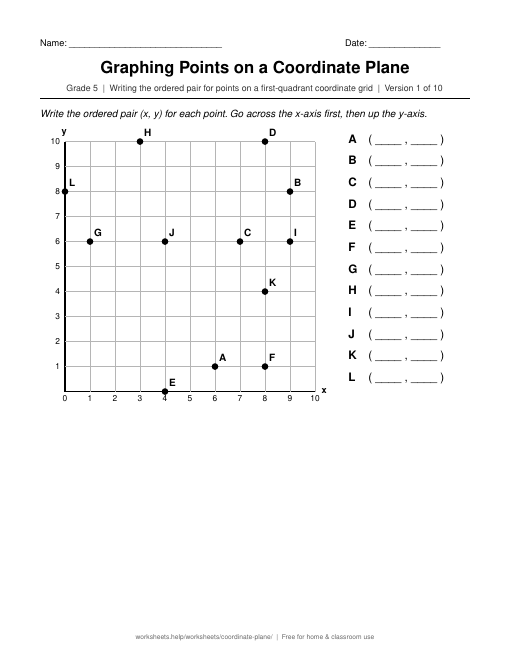 Graphing Points on a Coordinate Plane
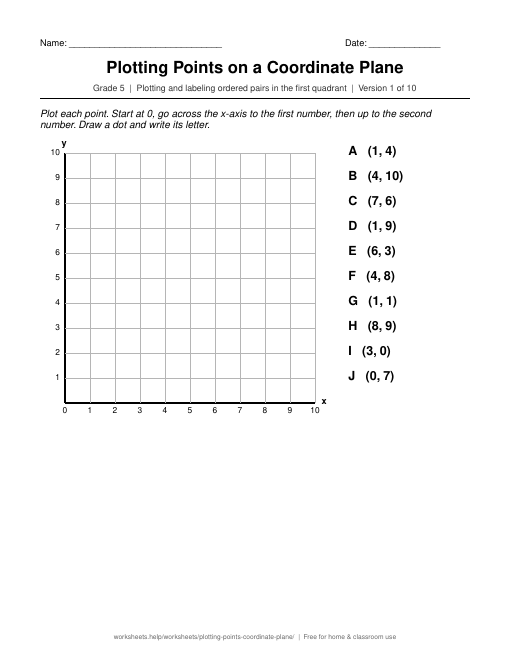 Plotting Points on a Coordinate Plane
About this worksheet
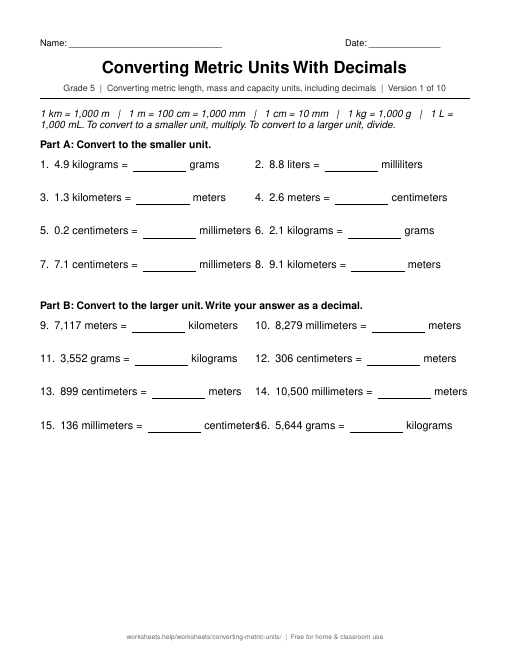
This fifth grade measurement worksheet practices metric conversions with decimals, which is where metric units and place value meet. Part A converts to a smaller unit, such as 2.6 meters to centimeters or 4.9 kilograms to grams. Part B converts to a larger unit and writes the answer as a decimal, such as 650 milliliters to 0.65 liters.
The page covers length (kilometers, meters, centimeters, millimeters), mass (kilograms, grams) and capacity (liters, milliliters). A conversion chart sits at the top of the page. Each of the 10 versions has new measurements.
How to use it: remind your child that metric units are based on 10, 100 and 1,000, so converting means multiplying or dividing by a power of 10. Going to a smaller unit gives a bigger number, so multiply; going to a larger unit gives a smaller number, so divide. Moving the decimal point one place for each zero is a quick way to do it. A meter stick with centimeter and millimeter marks is a great way to see these relationships.
The answer key shows every conversion. For whole-number conversions, try our Converting Units of Measurement worksheet and our Powers of 10 worksheet.