Plotting Points on a Coordinate Plane Worksheets for 5th Grade
Download PDF worksheetAnswer key (PDF)Worksheet + answer key (2 pages)
Prints on one US Letter page; the answer key is a separate page. Print at 100% / "Actual size" on US Letter paper. Free for personal and classroom use. Version 1 of 10. Choose another version.
Skill: Plotting and labeling ordered pairs in the first quadrant
Teaching tips and what to try next
Best for fifth graders who can already name the ordered pair of a point that is shown, as in Graphing Points on a Coordinate Plane. Taping a grid on the floor and having your child walk to a called-out pair, across first and then up, makes the order stick. When plotting feels steady, connect it to rules and graphs in Numerical Patterns and Ordered Pairs.
10 versions, each with its own answer key
Same skill and layout, a fresh set of problems in every version, so children can keep practicing without repeating a page. Problems are not repeated between versions unless a skill has only a small number of possible problems (for example, the addition facts within 10).
- Version 1: Sheet · Key · Both
- Version 2: Sheet · Key · Both
- Version 3: Sheet · Key · Both
- Version 4: Sheet · Key · Both
- Version 5: Sheet · Key · Both
- Version 6: Sheet · Key · Both
- Version 7: Sheet · Key · Both
- Version 8: Sheet · Key · Both
- Version 9: Sheet · Key · Both
- Version 10: Sheet · Key · Both
Download all 10 versions (one PDF)All 10 answer keys (PDF)
Make a new one
Want more practice? Make a brand-new Plotting Points on a Coordinate Plane sheet with fresh problems and its matching answer key, created right in your browser.
Related worksheets
About this worksheet
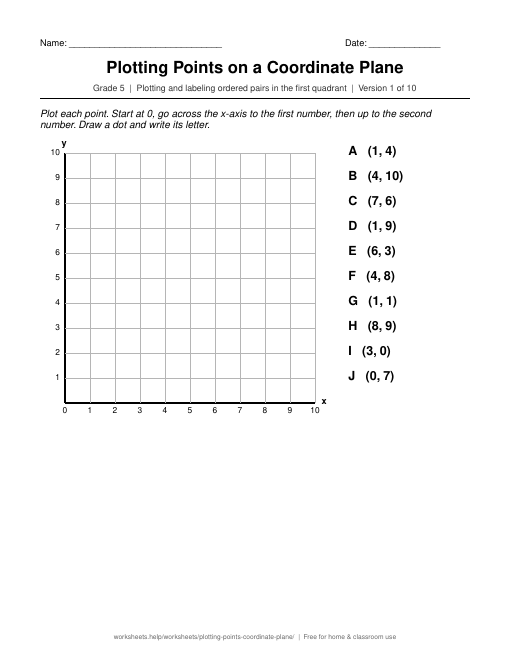
In fifth grade, children learn to locate points on a coordinate plane using ordered pairs. Reading the pair for a point that is already drawn is one half of the skill. Plotting a point from its pair is the other half. This fifth-grade worksheet gives practice plotting ten points in the first quadrant.
The page shows a coordinate grid from 0 to 10 on both axes. A list beside the grid gives ten ordered pairs, labeled A to J. Children find each point by starting at the origin, moving across the x-axis by the first number, and then moving up by the second number. They draw a dot at that spot and write its letter next to it. A point can also land right on an axis, such as (0, 6), which checks that children know where zero is. No two points are right next to each other, so the labels stay easy to read. Each of the ten versions has new points and its own answer key.
How to use it: before the worksheet, practice with one point using a finger. Say "across first, then up" as your child moves along the grid. The most common mistake is to swap the two numbers and plot (3, 7) at (7, 3), so ask your child to check one or two points by reading them back.
The answer key shows each point in place with its label. To read ordered pairs instead, try our Graphing Points on a Coordinate Plane worksheet. For patterns that make ordered pairs, try our Numerical Patterns and Ordered Pairs worksheet.