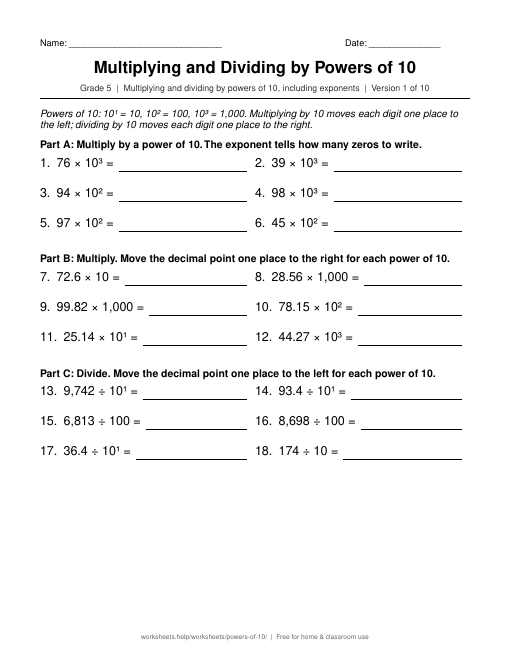
Multiplying and Dividing by Powers of 10 Worksheets for 5th Grade
Download PDF worksheetAnswer key (PDF)Worksheet + answer key (2 pages)
Prints on one US Letter page; the answer key is a separate page. Print at 100% / "Actual size" on US Letter paper. Free for personal and classroom use. Version 1 of 10. Choose another version.
Skill: Multiplying and dividing by powers of 10, including exponents
Teaching tips and what to try next
Multiplying by 10 moves every digit one place left, which is why the decimal point seems to move. Exponents like 10³ show how many times 10 is a factor. Encourage place value language instead of "add zeros." Next, try Multiplying Decimals or Converting Metric Units With Decimals.
10 versions, each with its own answer key
Same skill and layout, a fresh set of problems in every version, so children can keep practicing without repeating a page. Problems are not repeated between versions unless a skill has only a small number of possible problems (for example, the addition facts within 10).
- Version 1: Sheet · Key · Both
- Version 2: Sheet · Key · Both
- Version 3: Sheet · Key · Both
- Version 4: Sheet · Key · Both
- Version 5: Sheet · Key · Both
- Version 6: Sheet · Key · Both
- Version 7: Sheet · Key · Both
- Version 8: Sheet · Key · Both
- Version 9: Sheet · Key · Both
- Version 10: Sheet · Key · Both
Download all 10 versions (one PDF)All 10 answer keys (PDF)
Make a new one
Want more practice? Make a brand-new Multiplying and Dividing by Powers of 10 sheet with fresh problems and its matching answer key, created right in your browser.
Related worksheets
About this worksheet
Each place in our number system is ten times the place to its right. That is why multiplying by 10 moves every digit one place to the left, and dividing by 10 moves every digit one place to the right. This fifth-grade worksheet uses that pattern with eighteen problems that multiply and divide by 10, 100, and 1,000.
In Part A, students multiply whole numbers by a power of 10 written with an exponent, such as 45 × 10³. The exponent tells how many zeros to write, so 45 × 10³ = 45,000. In Part B, students multiply decimals, such as 3.45 × 100 = 345, and in Part C they divide whole numbers and decimals, such as 56 ÷ 100 = 0.56. Parts B and C mix the two ways of writing the same power, such as 100 and 10², so students get comfortable with both. Every answer is exact, and the ten versions use new numbers.
How to use it: before starting, write 10¹ = 10, 10² = 100, and 10³ = 1,000 at the top of the page. For decimals, have students count the zeros or the exponent, then move the decimal point that many places: right for multiplying, left for dividing. A place-value chart helps students see why 7 ÷ 100 needs zeros to hold the empty places to become 0.07. As a quick check, ask, "Should the answer be bigger or smaller than the number I started with?"
The answer key lists every answer. This worksheet supports Common Core standard 5.NBT.A.2. Continue with our Multiplying Decimals by Whole Numbers worksheet and our Decimal Place Value worksheet.