10 More, 10 Less, 100 More, 100 Less Worksheets for 2nd Grade
Download PDF worksheetAnswer key (PDF)Worksheet + answer key (2 pages)
Prints on one US Letter page; the answer key is a separate page. Print at 100% / "Actual size" on US Letter paper. Free for personal and classroom use. Version 1 of 10. Choose another version.
Skill: Finding 10 more, 10 less, 100 more and 100 less than three-digit numbers
Teaching tips and what to try next
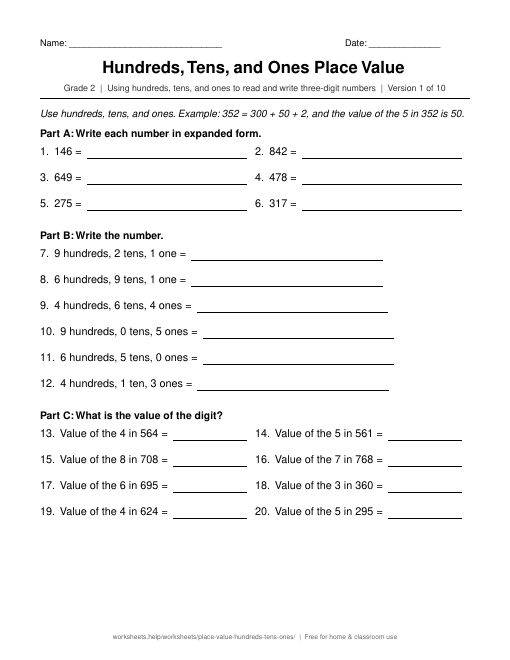
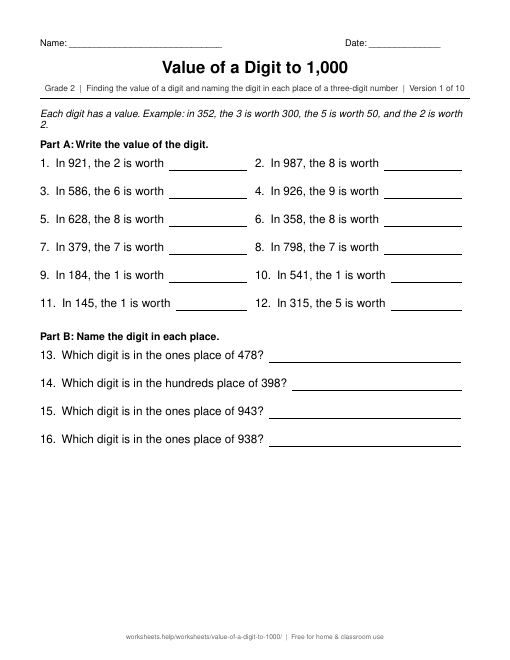
Right for second graders who read three-digit numbers and know the value of each digit, as in Hundreds, Tens, and Ones Place Value. Rows near a hundred, such as 10 more than 395, catch many children, so ask them to say the new number aloud before writing it. Practice the moves as equations in Adding and Subtracting 10 and 100, or count across hundreds in Counting Within 1,000: Missing Numbers.
10 versions, each with its own answer key
Same skill and layout, a fresh set of problems in every version, so children can keep practicing without repeating a page. Problems are not repeated between versions unless a skill has only a small number of possible problems (for example, the addition facts within 10).
- Version 1: Sheet · Key · Both
- Version 2: Sheet · Key · Both
- Version 3: Sheet · Key · Both
- Version 4: Sheet · Key · Both
- Version 5: Sheet · Key · Both
- Version 6: Sheet · Key · Both
- Version 7: Sheet · Key · Both
- Version 8: Sheet · Key · Both
- Version 9: Sheet · Key · Both
- Version 10: Sheet · Key · Both
Download all 10 versions (one PDF)All 10 answer keys (PDF)
Make a new one
Want more practice? Make a brand-new 10 More, 10 Less, 100 More, 100 Less sheet with fresh problems and its matching answer key, created right in your browser.
Related worksheets
About this worksheet
Second graders learn to add or subtract 10 or 100 in their head, without lining numbers up on paper. The trick is place value: adding 10 changes the tens digit, and adding 100 changes the hundreds digit, while the other digits stay the same. This second-grade worksheet practices all four moves with three-digit numbers.
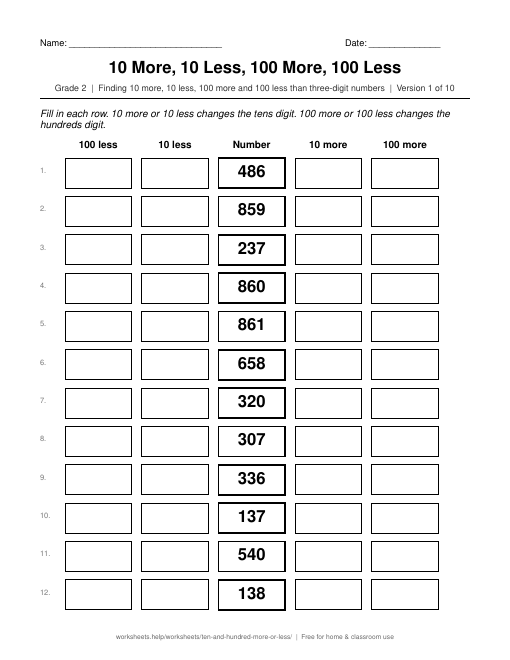
The page is a table with twelve rows. Each row has a three-digit number from 110 to 889 in the middle box. Children fill in the boxes for 100 less, 10 less, 10 more and 100 more. Some numbers have a 9 or a 0 in the tens place, so adding or taking away 10 sometimes changes the hundreds digit too, as in 395 and 405. Those rows are worth a second look. Each of the ten versions has new numbers and its own answer key.
How to use it: before starting, build one number with base-ten blocks, such as 3 flats, 4 rods and 6 cubes for 346. Add a rod, then take one away, then do the same with a flat, and say each new number. Ask your child which digit changed each time. On the page, encourage your child to touch the digit that will change before writing. If a row crosses a hundred, like 10 more than 293, have your child count on by tens out loud: 293, 303.
The answer key shows all four numbers for every row. For two-digit numbers, try our 10 More and 10 Less worksheet. To add and subtract 10 and 100 as equations, try our Adding and Subtracting 10 and 100 worksheet.