Adding and Subtracting 10 and 100 Worksheets for 2nd Grade
Download PDF worksheetAnswer key (PDF)Worksheet + answer key (2 pages)
Prints on one US Letter page; the answer key is a separate page. Print at 100% / "Actual size" on US Letter paper. Free for personal and classroom use. Version 1 of 10. Choose another version.
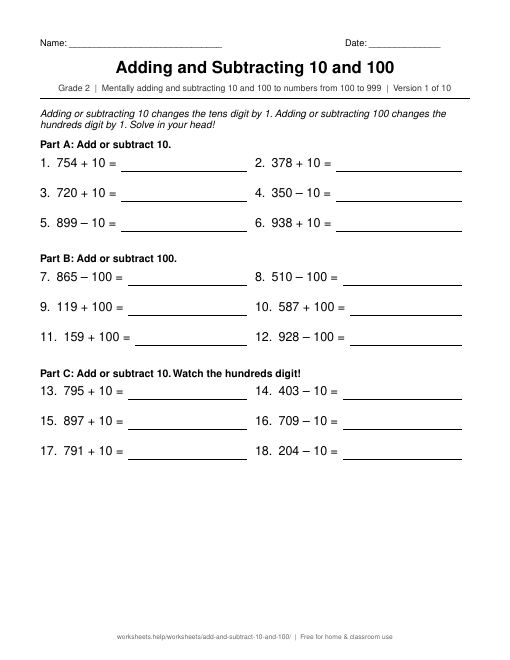
Skill: Mentally adding and subtracting 10 and 100 to numbers from 100 to 999
Teaching tips and what to try next
Second graders are ready for this once they can read three-digit numbers and say what each digit is worth. The goal is mental math, so let your child say each answer before writing it and avoid lining up the numbers in columns. If two-digit jumps are still shaky, go back to 10 More and 10 Less; next, try Three-Digit Addition With Regrouping and Three-Digit Subtraction With Regrouping.
10 versions, each with its own answer key
Same skill and layout, a fresh set of problems in every version, so children can keep practicing without repeating a page. Problems are not repeated between versions unless a skill has only a small number of possible problems (for example, the addition facts within 10).
- Version 1: Sheet · Key · Both
- Version 2: Sheet · Key · Both
- Version 3: Sheet · Key · Both
- Version 4: Sheet · Key · Both
- Version 5: Sheet · Key · Both
- Version 6: Sheet · Key · Both
- Version 7: Sheet · Key · Both
- Version 8: Sheet · Key · Both
- Version 9: Sheet · Key · Both
- Version 10: Sheet · Key · Both
Download all 10 versions (one PDF)All 10 answer keys (PDF)
Make a new one
Want more practice? Make a brand-new Adding and Subtracting 10 and 100 sheet with fresh problems and its matching answer key, created right in your browser.
Related worksheets
About this worksheet
When you add 10 to a number, only the tens digit goes up by one. When you add 100, only the hundreds digit changes. Second graders learn to use this pattern to add and subtract 10 and 100 in their heads, without lining up columns. This second-grade worksheet gives eighteen problems with three-digit numbers to build that mental math skill.
In Part A, children add or subtract 10, such as 347 + 10 = 357 or 562 – 10 = 552. In Part B, they add or subtract 100, such as 418 + 100 = 518. Part C is the challenge round: adding or subtracting 10 changes the hundreds digit too, such as 395 + 10 = 405 or 703 – 10 = 693. These are the problems where children most often make mistakes, so they get a section of their own. Every answer is a three-digit number, and the ten versions use new numbers.
How to use it: ask your child to point to the digit that will change before writing anything. Base-ten blocks or a hundred chart make the pattern easy to see: moving down a row on a hundred chart adds 10. For Part C, model the trade out loud: "395 has 9 tens. One more ten makes 10 tens, which is 1 more hundred." Children who finish quickly can make a chain, adding 10 five times in a row and saying each number.
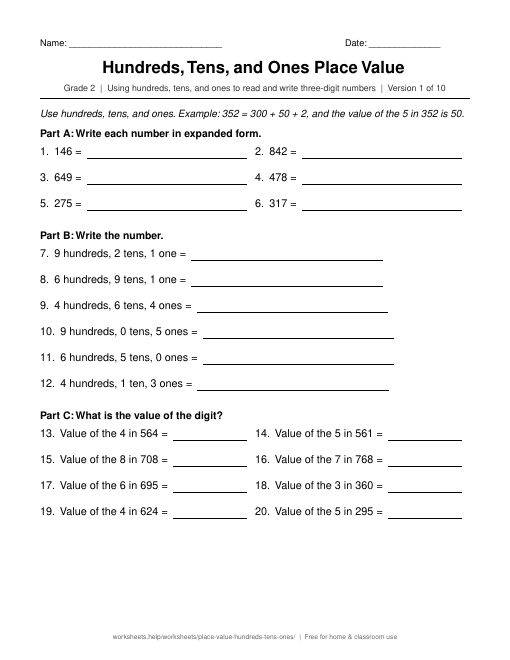
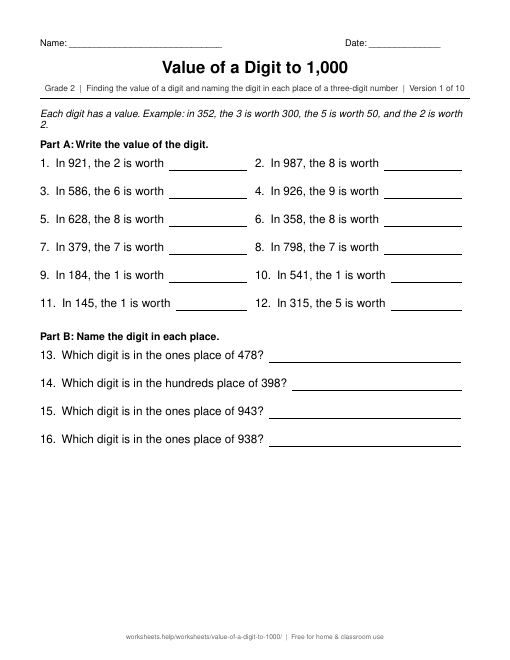
The answer key lists every answer. This worksheet supports Common Core standard 2.NBT.B.8. For a first step, try our 10 More and 10 Less worksheet, and review place value with our Hundreds, Tens, and Ones Place Value worksheet.