Doubling and Halving Numbers Within 100 Worksheets for 2nd Grade
Download PDF worksheetAnswer key (PDF)Worksheet + answer key (2 pages)
Prints on one US Letter page; the answer key is a separate page. Print at 100% / "Actual size" on US Letter paper. Free for personal and classroom use. Version 1 of 10. Choose another version.
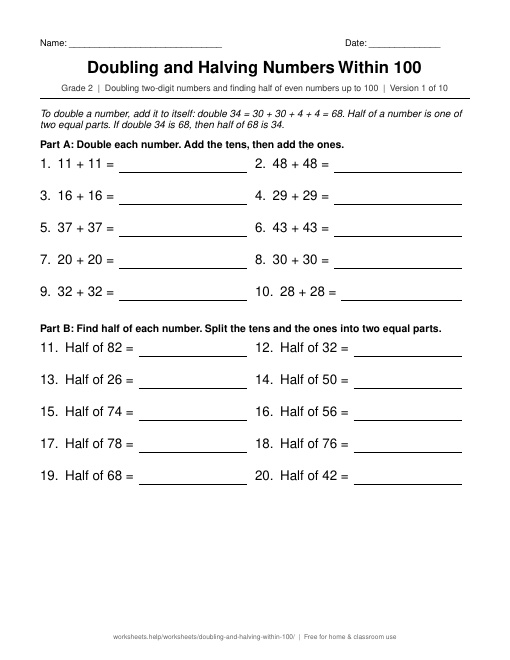
Skill: Doubling two-digit numbers and finding half of even numbers up to 100
Teaching tips and what to try next
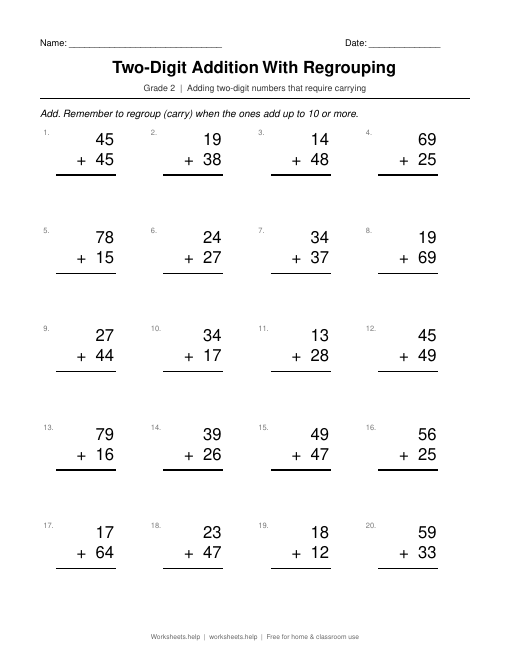
Suited to second graders who know their doubles to 10 from Doubles Facts to 20. Building a number with base-ten blocks, then making an identical copy, shows why double 34 is double 30 plus double 4. Halving is easiest when children split the tens first and then the ones, and Two-Digit Addition With Regrouping is useful for doubles like 37 that need a regroup.
10 versions, each with its own answer key
Same skill and layout, a fresh set of problems in every version, so children can keep practicing without repeating a page. Problems are not repeated between versions unless a skill has only a small number of possible problems (for example, the addition facts within 10).
- Version 1: Sheet · Key · Both
- Version 2: Sheet · Key · Both
- Version 3: Sheet · Key · Both
- Version 4: Sheet · Key · Both
- Version 5: Sheet · Key · Both
- Version 6: Sheet · Key · Both
- Version 7: Sheet · Key · Both
- Version 8: Sheet · Key · Both
- Version 9: Sheet · Key · Both
- Version 10: Sheet · Key · Both
Download all 10 versions (one PDF)All 10 answer keys (PDF)
Make a new one
Want more practice? Make a brand-new Doubling and Halving Numbers Within 100 sheet with fresh problems and its matching answer key, created right in your browser.
Related worksheets
About this worksheet
Doubling and halving are quick mental math tools. Once a child knows that double 35 is 70, they also know that half of 70 is 35, and they can use doubles to add numbers that are close together. Second graders add and subtract within 100 using place value, and doubling a two-digit number is a good place to practice that. This second-grade worksheet works on both skills.
Part A has ten numbers from 11 to 50 to double, written as additions such as 34 + 34. Part B has ten even numbers from 22 to 100, and children find half of each one. Some problems need regrouping, such as 47 + 47, where the ones add up to more than ten, and some do not. The instructions on the page suggest splitting the tens and the ones, so children see that double 34 is double 30 plus double 4. Each of the ten versions has a new mix of numbers and its own answer key.
How to use it: show double 23 with base-ten blocks: two tens and three ones, twice. Push the tens together, then the ones, and count. For halving, start with the same blocks and share them into two equal piles. When a ten cannot be split evenly, as in half of 70, trade one ten for ten ones first. Ask your child to check each half by doubling it again.
The answer key gives every answer. For smaller doubles, try our Doubles Facts to 20 worksheet. For more adding within 100, try our Two-Digit Addition With Regrouping worksheet.