Hundreds, Tens, and Ones Place Value
Download PDF worksheetAnswer key (PDF)Worksheet + answer key (2 pages)
Prints on one US Letter page; the answer key is a separate page. Print at 100% / "Actual size" on US Letter paper. Free for personal and classroom use. Version 1 of 10. Choose another version.
Skill: Using hundreds, tens, and ones to read and write three-digit numbers
10 versions, each with its own answer key
Same skill and layout, a fresh set of problems in every version, so children can keep practicing without repeating a page. Problems are not repeated between versions unless a skill has only a small number of possible problems (for example, the addition facts within 10).
- Version 1: Sheet · Key · Both
- Version 2: Sheet · Key · Both
- Version 3: Sheet · Key · Both
- Version 4: Sheet · Key · Both
- Version 5: Sheet · Key · Both
- Version 6: Sheet · Key · Both
- Version 7: Sheet · Key · Both
- Version 8: Sheet · Key · Both
- Version 9: Sheet · Key · Both
- Version 10: Sheet · Key · Both
Download all 10 versions (one PDF)All 10 answer keys (PDF)
Make a new one
Want more practice? Make a brand-new Hundreds, Tens, and Ones Place Value sheet with fresh problems and its matching answer key, created right in your browser.
Related worksheets
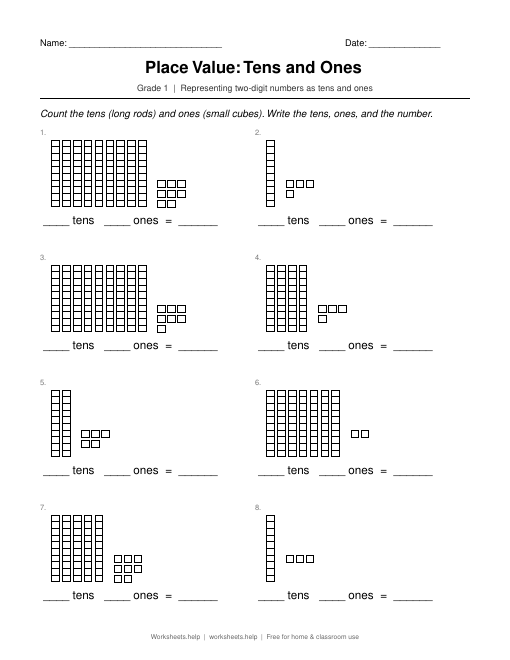
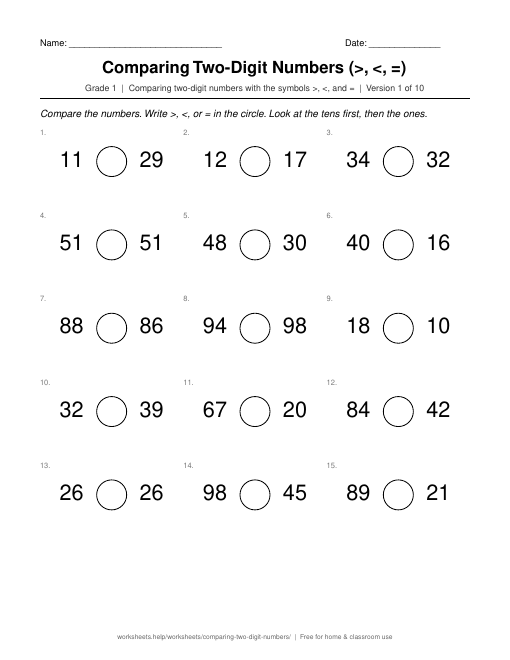
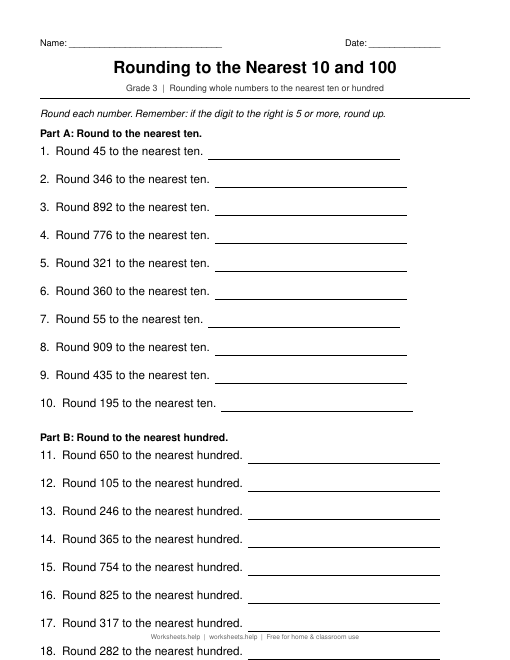
About this worksheet
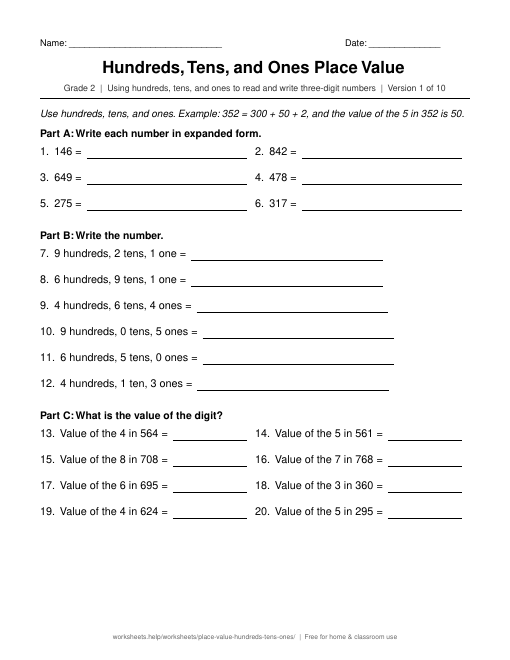
In second grade, place value grows from tens and ones to hundreds, tens, and ones. This second-grade worksheet practices that idea in three ways. Part A asks students to write six three-digit numbers in expanded form, such as 352 = 300 + 50 + 2. Part B gives six numbers as hundreds, tens, and ones, and students write the number. Part C asks for the value of one digit in eight numbers, such as the value of the 5 in 452.
Some Part B problems have zero tens or zero ones, such as 4 hundreds, 0 tens, 6 ones. Writing 406 shows that zero holds the tens place. In Part C, the digit asked about appears only once in each number, so every answer is clear.
How to use it: base-ten blocks make this skill concrete. Build a number with flats, rods, and cubes, then write it three ways: as a number, in expanded form, and in words. If a student writes 46 instead of 406, build it with blocks and ask, "How many tens do we have?"
The answer key lists every answer. This worksheet supports Common Core standards 2.NBT.A.1 (understand that the three digits of a three-digit number represent amounts of hundreds, tens, and ones) and 2.NBT.A.3 (read and write numbers to 1000 using base-ten numerals, number names, and expanded form). It leads naturally into our Three-Digit Addition With Regrouping worksheet.