True or False Equations Worksheets for 1st Grade
Download PDF worksheetAnswer key (PDF)Worksheet + answer key (2 pages)
Prints on one US Letter page; the answer key is a separate page. Print at 100% / "Actual size" on US Letter paper. Free for personal and classroom use. Version 1 of 10. Choose another version.
Skill: Understanding the equal sign by deciding if equations are true or false
Teaching tips and what to try next
First graders who can add and subtract within 20 are ready for this, and it pays off later, since a solid grasp of the equal sign makes missing-number problems and algebra much easier. Watch for children who mark 15 = 8 + 7 false just because it looks backward. Next, find unknowns in Missing Numbers in Subtraction Within 20 or connect facts in Doubles and Near Doubles Addition.
10 versions, each with its own answer key
Same skill and layout, a fresh set of problems in every version, so children can keep practicing without repeating a page. Problems are not repeated between versions unless a skill has only a small number of possible problems (for example, the addition facts within 10).
- Version 1: Sheet · Key · Both
- Version 2: Sheet · Key · Both
- Version 3: Sheet · Key · Both
- Version 4: Sheet · Key · Both
- Version 5: Sheet · Key · Both
- Version 6: Sheet · Key · Both
- Version 7: Sheet · Key · Both
- Version 8: Sheet · Key · Both
- Version 9: Sheet · Key · Both
- Version 10: Sheet · Key · Both
Download all 10 versions (one PDF)All 10 answer keys (PDF)
Make a new one
Want more practice? Make a brand-new True or False Equations sheet with fresh problems and its matching answer key, created right in your browser.
Related worksheets
About this worksheet
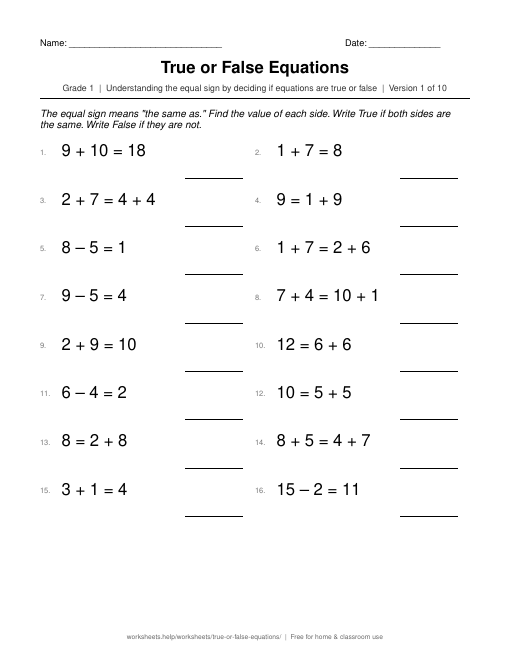
Many children think the equal sign means "write the answer next." In first grade, they learn that it really means "is the same as": both sides of an equation must have the same value. This first-grade worksheet builds that idea with sixteen equations, and children decide whether each one is true or false.
The equations come in four forms. Some look familiar, such as 6 + 7 = 13. Some put the total first, such as 15 = 8 + 7, which surprises children who expect the answer on the right. Some have addition on both sides, such as 4 + 5 = 3 + 6, so children must find the value of each side. The last kind uses subtraction, such as 12 – 4 = 8. Every page has eight true and eight false equations, and each false one is off by only 1 or 2, so children have to work out each side instead of guessing. All numbers stay within 20.
How to use it: draw a balance scale on scrap paper and explain that an equation is true when the two sides balance. Have your child find the value of the left side, then the right side, and compare. For equations like 4 + 5 = 3 + 6, counters on two plates make the idea easy to see. When an equation is false, ask your child how to change one number to make it true.
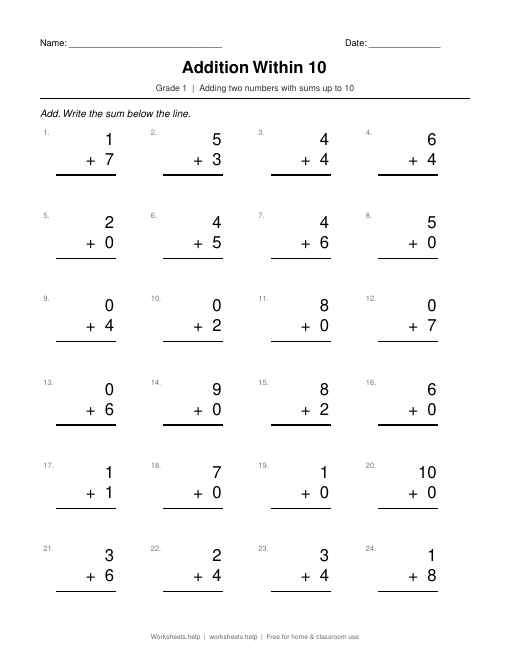
The answer key lists True or False for every equation. This worksheet supports Common Core standard 1.OA.D.7. Practice the facts with our Addition Within 20 worksheet and our Fact Families Within 20 worksheet.