Balancing Equations Within 20 Worksheets for 1st Grade
Download PDF worksheetAnswer key (PDF)Worksheet + answer key (2 pages)
Prints on one US Letter page; the answer key is a separate page. Print at 100% / "Actual size" on US Letter paper. Free for personal and classroom use. Version 1 of 10. Choose another version.
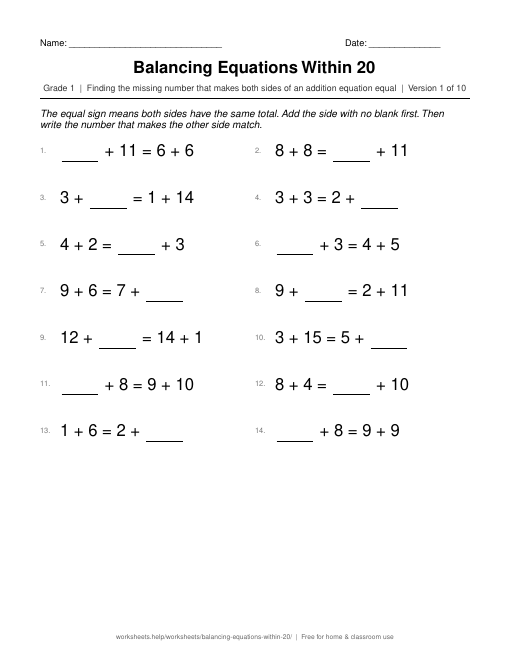
Skill: Finding the missing number that makes both sides of an addition equation equal
Teaching tips and what to try next
Pairs well with first graders who add within 20 comfortably and have judged equations in True or False Equations. Children who write the left-side total in the blank are reading the equal sign as an answer cue, so cover the right side and ask what the left side makes first. Next, try Missing Addends Within 20 or the related standard page 1.OA.D.8.
10 versions, each with its own answer key
Same skill and layout, a fresh set of problems in every version, so children can keep practicing without repeating a page. Problems are not repeated between versions unless a skill has only a small number of possible problems (for example, the addition facts within 10).
- Version 1: Sheet · Key · Both
- Version 2: Sheet · Key · Both
- Version 3: Sheet · Key · Both
- Version 4: Sheet · Key · Both
- Version 5: Sheet · Key · Both
- Version 6: Sheet · Key · Both
- Version 7: Sheet · Key · Both
- Version 8: Sheet · Key · Both
- Version 9: Sheet · Key · Both
- Version 10: Sheet · Key · Both
Download all 10 versions (one PDF)All 10 answer keys (PDF)
Make a new one
Want more practice? Make a brand-new Balancing Equations Within 20 sheet with fresh problems and its matching answer key, created right in your browser.
Related worksheets
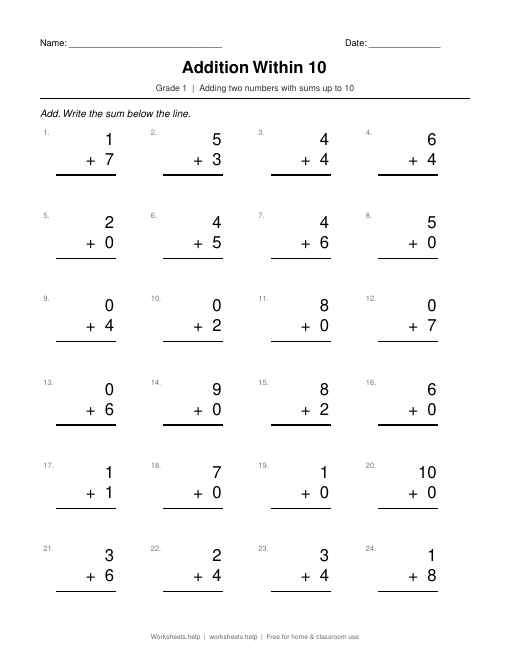
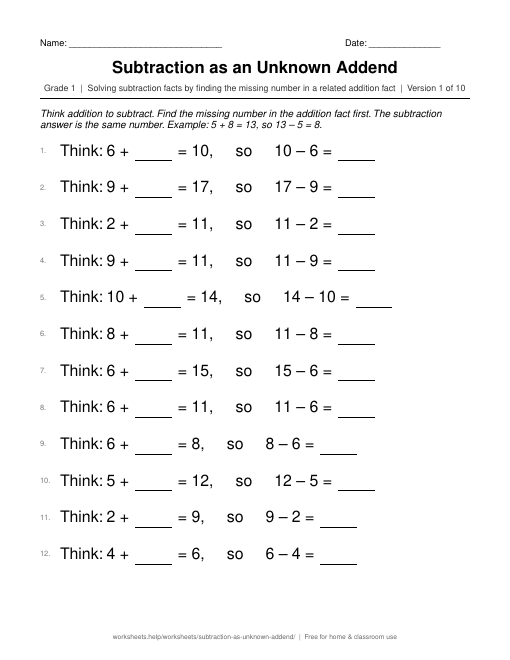
About this worksheet
Many children think the equal sign means "write the answer next." An equation like 8 + 5 = ___ + 6 shows them that it really means "the same as," because both sides have to add up to the same total. First graders are expected to understand the meaning of the equal sign and to find unknown numbers in equations, and this first-grade worksheet puts both ideas on one page.
The page has fourteen equations in two columns. Each one has two numbers added on the left and two numbers added on the right, and both sides make the same total, up to 20. One of the four numbers is missing. Sometimes the blank is on the right side and sometimes on the left, and the right side is never just the left side turned around, so children have to work out each total. Each of the ten versions has new equations and its own answer key.
How to use it: show your child a simple balance or seesaw, or draw one, and explain that both sides must weigh the same. Then teach a two-step plan. Find the total of the side that has no blank. Next, ask what number goes with the number you can see to make that total. For 8 + 5 = ___ + 6, the left side is 13, and 6 + 7 = 13, so the answer is 7.
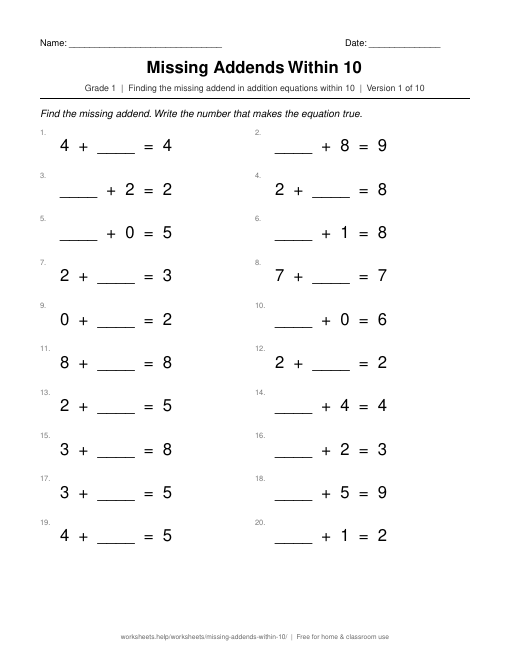
The answer key shows every missing number. For deciding whether equations are true, try our True or False Equations worksheet. For one blank and a total, try our Missing Addends Within 20 worksheet.