Doubles and Near Doubles Addition Worksheets for 1st Grade
Download PDF worksheetAnswer key (PDF)Worksheet + answer key (2 pages)
Prints on one US Letter page; the answer key is a separate page. Print at 100% / "Actual size" on US Letter paper. Free for personal and classroom use. Version 1 of 10. Choose another version.
Skill: Adding doubles and using doubles to solve near doubles
Teaching tips and what to try next
Doubles (6 + 6) are often the first facts children remember, and near doubles (6 + 7) use them as a shortcut: double 6, then one more. Ask your child to say the double they used for each near double. Use the strategy in Addition Within 20, or add three numbers in Adding Three Numbers.
10 versions, each with its own answer key
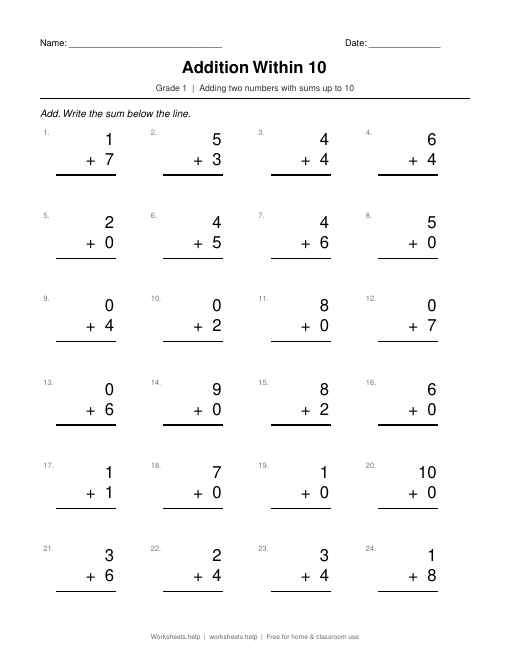
Same skill and layout, a fresh set of problems in every version, so children can keep practicing without repeating a page. Problems are not repeated between versions unless a skill has only a small number of possible problems (for example, the addition facts within 10).
- Version 1: Sheet · Key · Both
- Version 2: Sheet · Key · Both
- Version 3: Sheet · Key · Both
- Version 4: Sheet · Key · Both
- Version 5: Sheet · Key · Both
- Version 6: Sheet · Key · Both
- Version 7: Sheet · Key · Both
- Version 8: Sheet · Key · Both
- Version 9: Sheet · Key · Both
- Version 10: Sheet · Key · Both
Download all 10 versions (one PDF)All 10 answer keys (PDF)
Make a new one
Want more practice? Make a brand-new Doubles and Near Doubles Addition sheet with fresh problems and its matching answer key, created right in your browser.
Related worksheets
About this worksheet
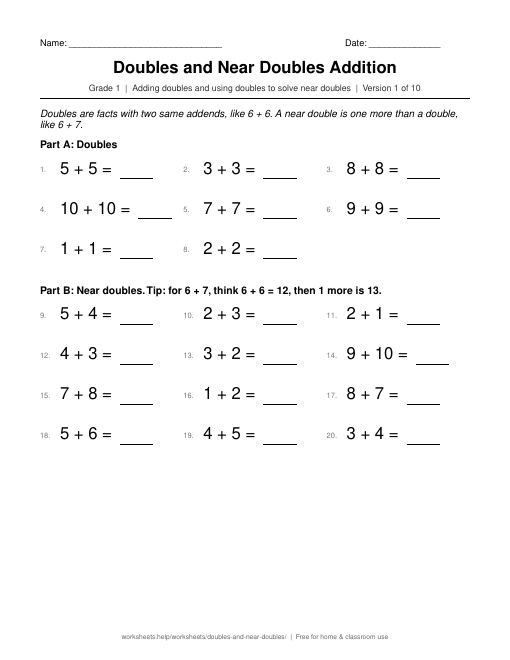
Doubles facts, such as 4 + 4 and 7 + 7, are some of the easiest facts to remember. Once they know them, they can use them to solve near doubles, such as 7 + 8: think 7 + 7 = 14, then one more is 15. This first-grade worksheet practices both, so children learn a strategy instead of counting on their fingers.
Part A has eight doubles facts from 1 + 1 to 10 + 10. Part B has twelve near doubles, where one addend is one more than the other, written in both orders, such as 5 + 6 and 6 + 5. A tip on the sheet shows how to turn each near double into a double plus one. There are only ten doubles and eighteen near doubles up to 10 + 9, so the ten versions use every one of them before any fact repeats.
How to use it: start by finding doubles in real life. An egg carton shows 6 + 6, a spider has 4 + 4 legs, and your two hands show 5 + 5. Say the doubles out loud together until they feel automatic. For Part B, ask your child, "Which double is hiding in this fact?" and have them say the double first, then add one. Children can check a few answers with objects.
The answer key lists every sum. This worksheet supports Common Core standard 1.OA.C.6 (add and subtract within 20, using strategies such as making ten and using known sums like 6 + 6 + 1 = 13). Practice more facts with our Addition Within 20 worksheet, and try our Adding Three Numbers worksheet next.