Commutative Property of Addition Worksheets for 1st Grade
Download PDF worksheetAnswer key (PDF)Worksheet + answer key (2 pages)
Prints on one US Letter page; the answer key is a separate page. Print at 100% / "Actual size" on US Letter paper. Free for personal and classroom use. Version 1 of 10. Choose another version.
Skill: Using turnaround facts: changing the order of addends does not change the sum
Teaching tips and what to try next
Best for first graders who know many facts within 20 and are starting to look for shortcuts. Encourage your child to start with the bigger number and count on, since the turnaround fact gives the same sum with fewer counts. Facts made from the same three numbers are in Fact Families Within 20, and grouping three addends is in Adding Three Numbers.
10 versions, each with its own answer key
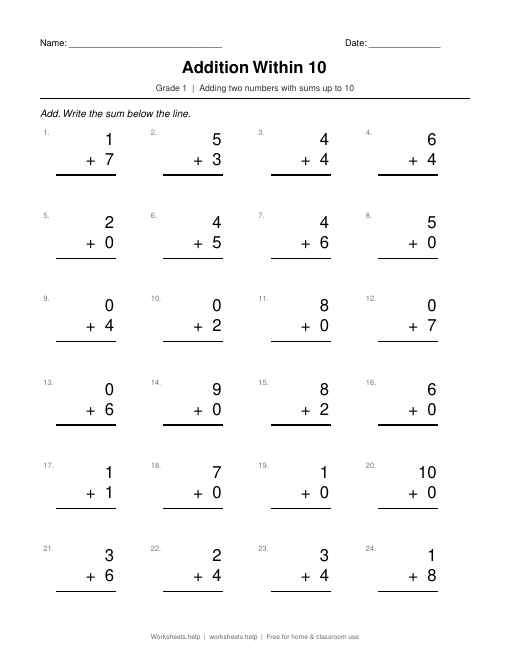
Same skill and layout, a fresh set of problems in every version, so children can keep practicing without repeating a page. Problems are not repeated between versions unless a skill has only a small number of possible problems (for example, the addition facts within 10).
- Version 1: Sheet · Key · Both
- Version 2: Sheet · Key · Both
- Version 3: Sheet · Key · Both
- Version 4: Sheet · Key · Both
- Version 5: Sheet · Key · Both
- Version 6: Sheet · Key · Both
- Version 7: Sheet · Key · Both
- Version 8: Sheet · Key · Both
- Version 9: Sheet · Key · Both
- Version 10: Sheet · Key · Both
Download all 10 versions (one PDF)All 10 answer keys (PDF)
Make a new one
Want more practice? Make a brand-new Commutative Property of Addition sheet with fresh problems and its matching answer key, created right in your browser.
Related worksheets
About this worksheet
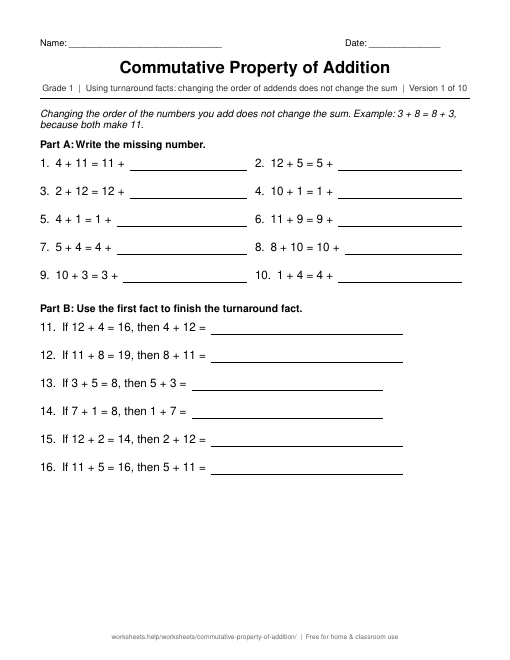
When you add two numbers, the order does not matter: 3 + 8 and 8 + 3 both make 11. This is called the commutative property of addition, and many classrooms call the pairs turnaround facts. First graders are expected to apply properties of operations as strategies to add, and this first grade worksheet turns that property into a quick shortcut.
The page has two parts. Part A has ten equations such as 4 + 11 = 11 + ___, where both sides must be equal, so the missing number is the addend that moved. Part B has six problems that give a known fact, such as "If 5 + 9 = 14," and ask children to finish the turnaround fact without adding again. Numbers go from 1 to 12, the two addends are always different, and every sum is 20 or less. Each of the ten versions has new facts and its own answer key.
How to use it: line up a short row of red blocks and blue blocks, count them, then turn the row around and count again. Your child will see the total stay the same. On the sheet, encourage them to look across the equal sign before doing any math. A common mistake in Part A is writing the sum on the line, so ask, "Does 4 + 11 equal 11 + 15?"
The answer key shows every missing number. For all four facts made from three numbers, try our Fact Families Within 20 worksheet. For adding three numbers in any order, try our Adding Three Numbers worksheet.