Prime and Composite Numbers Worksheets for 4th Grade
Download PDF worksheetAnswer key (PDF)Worksheet + answer key (2 pages)
Prints on one US Letter page; the answer key is a separate page. Print at 100% / "Actual size" on US Letter paper. Free for personal and classroom use. Version 1 of 10. Choose another version.
Skill: Deciding whether whole numbers from 2 to 100 are prime or composite
Teaching tips and what to try next
Suitable for fourth graders who know their multiplication facts and have started listing factor pairs. Keep a short list of the primes below 10 (2, 3, 5, 7) handy, since any number from 11 to 100 that none of them divide evenly is prime. Find factor pairs first in Factors, Multiples, Prime and Composite, and refresh facts with Division Facts 1-10.
10 versions, each with its own answer key
Same skill and layout, a fresh set of problems in every version, so children can keep practicing without repeating a page. Problems are not repeated between versions unless a skill has only a small number of possible problems (for example, the addition facts within 10).
- Version 1: Sheet · Key · Both
- Version 2: Sheet · Key · Both
- Version 3: Sheet · Key · Both
- Version 4: Sheet · Key · Both
- Version 5: Sheet · Key · Both
- Version 6: Sheet · Key · Both
- Version 7: Sheet · Key · Both
- Version 8: Sheet · Key · Both
- Version 9: Sheet · Key · Both
- Version 10: Sheet · Key · Both
Download all 10 versions (one PDF)All 10 answer keys (PDF)
Make a new one
Want more practice? Make a brand-new Prime and Composite Numbers sheet with fresh problems and its matching answer key, created right in your browser.
Related worksheets
About this worksheet
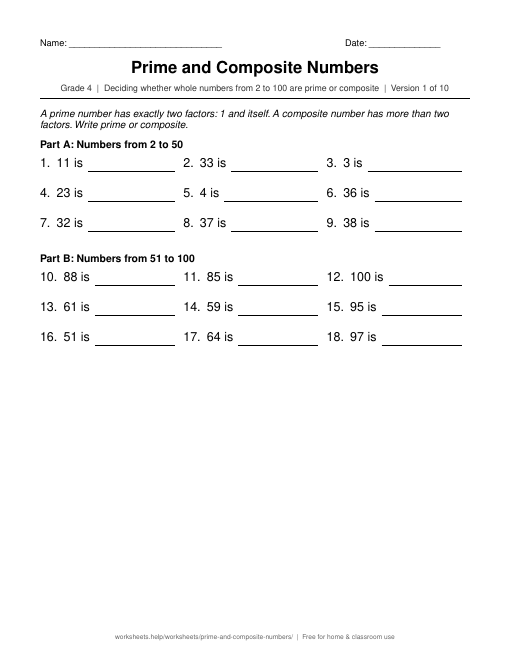
A prime number has exactly two factors, 1 and itself, while a composite number has more than two. Fourth graders learn to tell them apart for any whole number up to 100. This fourth-grade worksheet gives eighteen numbers to sort into prime and composite.
Part A has nine numbers from 2 to 50, and Part B has nine numbers from 51 to 100. Each part includes several primes mixed with composites, and children write prime or composite on the line after each number. Some composites are easy to spot, like even numbers and numbers ending in 5. Others take more thought, such as 51, 57, 87, or 91, which look prime but are not. Across the ten versions, every whole number from 2 to 100 appears before any number repeats, so the full set covers the whole range.
How to use it: teach your child a short checklist. Is the number even? Then it is composite, unless it is 2. Does it end in 0 or 5? Then it can be divided by 5. Do its digits add up to a multiple of 3? Then 3 is a factor. For numbers that pass these tests, try 7. If none of these divide the number evenly, it is prime. Remind your child that 2 is the only even prime and that 1 is neither prime nor composite, which is why 1 does not appear on the sheet.
The answer key lists the answer for each number. For factor pairs and multiples, try our Factors, Multiples, Prime and Composite worksheet. For fact review, try our Division Facts 1-10 worksheet.