Multiplying Decimals Worksheets for 5th Grade
Download PDF worksheetAnswer key (PDF)Worksheet + answer key (2 pages)
Prints on one US Letter page; the answer key is a separate page. Print at 100% / "Actual size" on US Letter paper. Free for personal and classroom use. Version 1 of 10. Choose another version.
Skill: Multiplying a decimal by a decimal (tenths and hundredths)
Teaching tips and what to try next
Multiply as whole numbers, then count the decimal places in both factors to place the point. An estimate (0.6 x 0.4 is less than 0.5) is a good check, since many children expect multiplication to always make a number bigger. Review Multiplying Decimals by Whole Numbers, then try Dividing Decimals by Decimals.
10 versions, each with its own answer key
Same skill and layout, a fresh set of problems in every version, so children can keep practicing without repeating a page. Problems are not repeated between versions unless a skill has only a small number of possible problems (for example, the addition facts within 10).
- Version 1: Sheet · Key · Both
- Version 2: Sheet · Key · Both
- Version 3: Sheet · Key · Both
- Version 4: Sheet · Key · Both
- Version 5: Sheet · Key · Both
- Version 6: Sheet · Key · Both
- Version 7: Sheet · Key · Both
- Version 8: Sheet · Key · Both
- Version 9: Sheet · Key · Both
- Version 10: Sheet · Key · Both
Download all 10 versions (one PDF)All 10 answer keys (PDF)
Make a new one
Want more practice? Make a brand-new Multiplying Decimals sheet with fresh problems and its matching answer key, created right in your browser.
Related worksheets
About this worksheet
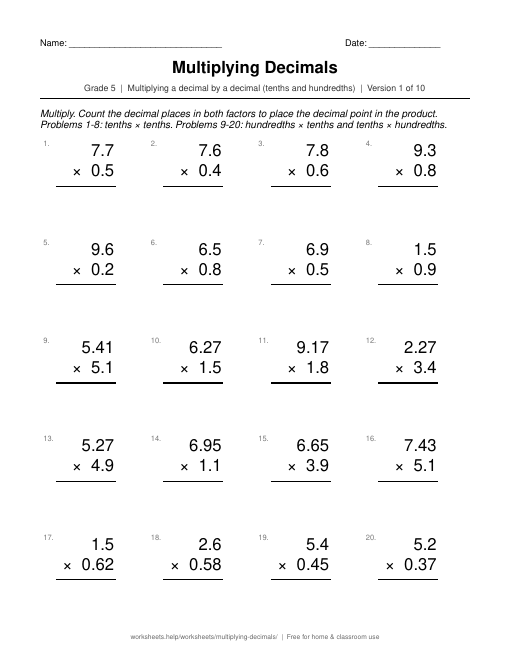
Once fifth graders can multiply a decimal by a whole number, the next step is multiplying two decimals. This worksheet has 20 problems written in columns. Problems 1-8 multiply tenths by tenths, such as 7.6 x 0.4. Problems 9-20 multiply hundredths by tenths, such as 6.27 x 1.5, and tenths by hundredths, so the products have two or three decimal places.
No factor ends in zero, so children cannot skip the decimal-place count. Answers are written in simplest form, without extra zeros at the end (6.5 x 0.8 = 5.2). Each of the 10 versions has new problems.
How to use it: show your child the three-step method. Multiply as if there were no decimal points, count the decimal places in both factors, then place the decimal point that many places from the right in the product. Then check with an estimate: 6.27 x 1.5 is about 6 x 1.5 = 9, so 9.405 makes sense and 94.05 does not. Talk about why multiplying by a number less than 1, like 0.4, gives a product smaller than the first factor.
The answer key shows every product in red. For an easier start, try our Multiplying Decimals by Whole Numbers worksheet.