Even or Odd? Pair the Dots
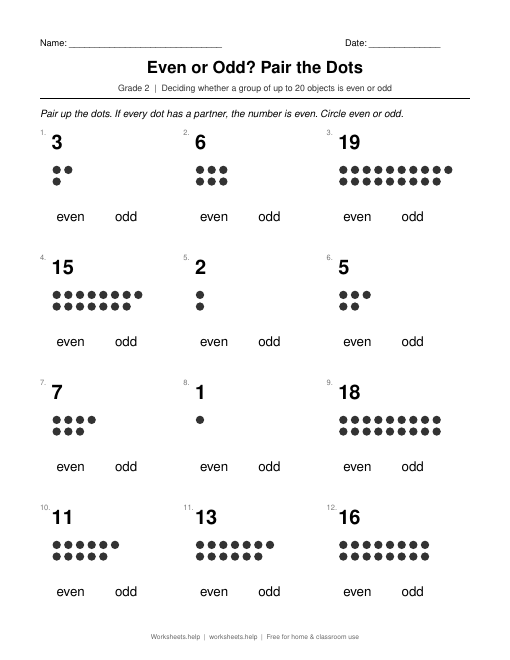
Skill: Deciding whether a group of up to 20 objects is even or odd
Download PDF worksheetAnswer key (PDF)
Free for personal and classroom use. Print at 100% / "Actual size" on US Letter paper.
About this worksheet
Even and odd numbers are a simple idea with a lot of math behind them. This second-grade worksheet shows twelve numbers from 1 to 20, each with a matching set of dots arranged in pairs. Children look at the dots, decide whether every dot has a partner, and circle even or odd. When every dot is paired, the number is even. When one dot is left over, the number is odd.
Seeing the dots in pairs helps children understand why a number is even or odd instead of just memorizing a list. It also connects to addition: an even number can be written as the sum of two equal numbers, such as 8 = 4 + 4, while an odd number cannot.
How to use it: have your child point to each pair of dots, or draw a loop around each pair, and look for a dot without a partner. Then ask them to write an equation with two equal addends for each even number, like 12 = 6 + 6. After a few problems, ask what they notice about the last digit.
The answer key circles the correct word for every number. This worksheet supports Common Core standard 2.OA.C.3 (determine whether a group of objects, up to 20, has an odd or even number of members, for example by pairing objects or counting them by 2s, and write an equation to express an even number as a sum of two equal addends).
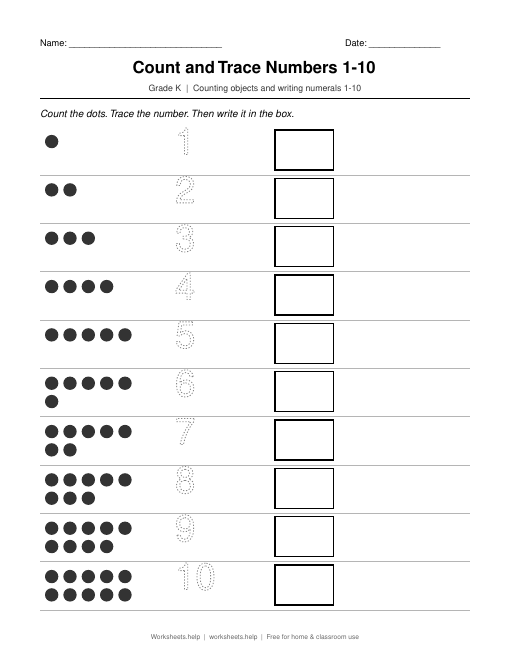 Count and Trace Numbers 1-10
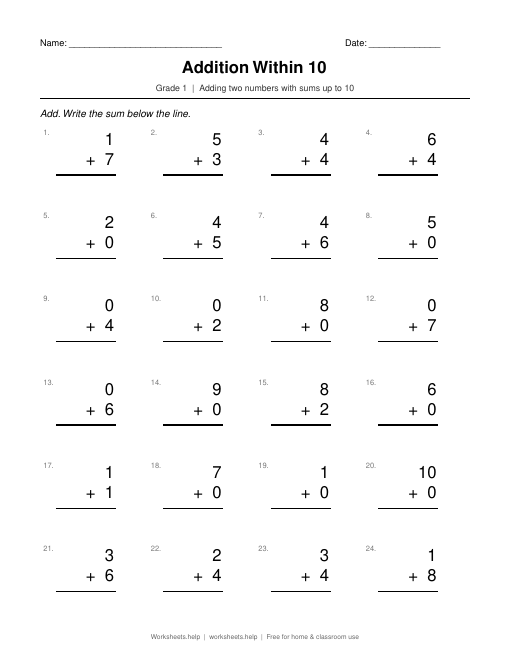 Addition Within 10
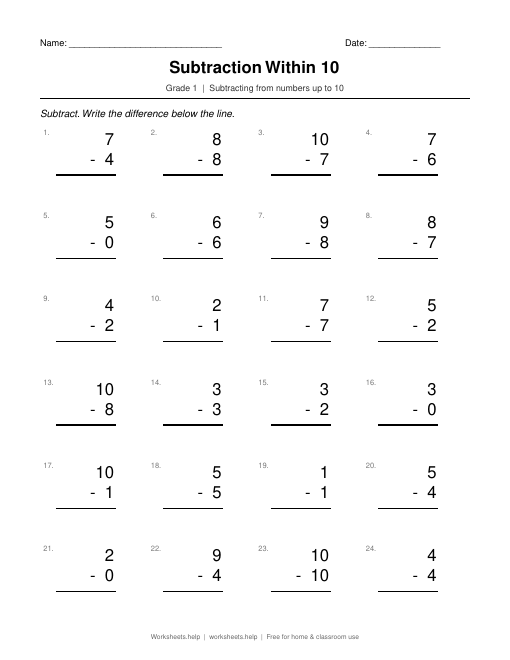 Subtraction Within 10