Counting by 5s to 100 Worksheets for 1st Grade
Download PDF worksheetAnswer key (PDF)Worksheet + answer key (2 pages)
Prints on one US Letter page; the answer key is a separate page. Print at 100% / "Actual size" on US Letter paper. Free for personal and classroom use. Version 1 of 10. Choose another version.
Skill: Counting forward and backward by fives within 100
Teaching tips and what to try next
Good for first graders who count to 100 by ones and are comfortable counting by tens. A row of nickels or a set of hands with fingers spread gives a real reason to count in fives, so let your child count something physical before writing. Then move on to Skip Counting by 5s, 10s and 100s for numbers past 100, or use fives on a clock face with Telling Time to the Nearest 5 Minutes.
10 versions, each with its own answer key
Same skill and layout, a fresh set of problems in every version, so children can keep practicing without repeating a page. Problems are not repeated between versions unless a skill has only a small number of possible problems (for example, the addition facts within 10).
- Version 1: Sheet · Key · Both
- Version 2: Sheet · Key · Both
- Version 3: Sheet · Key · Both
- Version 4: Sheet · Key · Both
- Version 5: Sheet · Key · Both
- Version 6: Sheet · Key · Both
- Version 7: Sheet · Key · Both
- Version 8: Sheet · Key · Both
- Version 9: Sheet · Key · Both
- Version 10: Sheet · Key · Both
Download all 10 versions (one PDF)All 10 answer keys (PDF)
Make a new one
Want more practice? Make a brand-new Counting by 5s to 100 sheet with fresh problems and its matching answer key, created right in your browser.
Related worksheets
About this worksheet
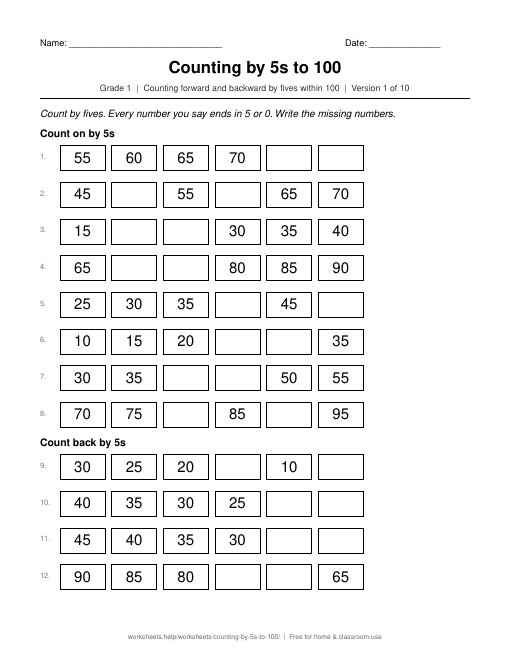
Counting by fives is one of the first skip counting patterns children learn, and it pays off quickly. It is the pattern for counting nickels, for reading the minutes on a clock, and for counting fingers on several hands. This first-grade worksheet gives twelve rows of practice counting by 5s within 100.
The first section has eight rows that count on by fives, starting from 0 or from a multiple of 5 up to 75. The second section has four rows that count back by fives, starting from numbers between 30 and 100. Each row shows six numbers in boxes, and two of the boxes are empty. Children write the missing numbers. The first number in every row is always shown, so there is a clear place to start. Each of the ten versions has new rows and its own answer key.
How to use it: count by fives out loud together a few times before the worksheet, clapping on each number. Point out that the numbers always end in 5 or 0, and that the endings take turns. That gives your child a quick check for every answer. Counting back is harder, so try it out loud first, such as 60, 55, 50. A hundred chart helps too: every number in the fifth and tenth columns is part of the pattern.
The answer key shows every missing number. To count by tens from any number, try our Counting by 10s From Any Number worksheet. For counting by 5s, 10s and 100s past 100, try our Skip Counting by 5s, 10s and 100s worksheet.