Counting Backward Within 20 Worksheets for 1st Grade
Download PDF worksheetAnswer key (PDF)Worksheet + answer key (2 pages)
Prints on one US Letter page; the answer key is a separate page. Print at 100% / "Actual size" on US Letter paper. Free for personal and classroom use. Version 1 of 10. Choose another version.
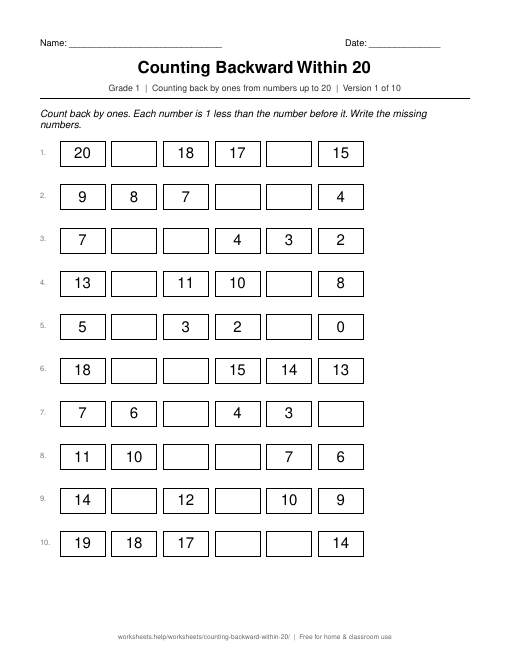
Skill: Counting back by ones from numbers up to 20
Teaching tips and what to try next
Good for first graders who count forward to 20 easily but slow down when counting down. Walking backward along a chalk number line on the sidewalk, one step per number, turns the skill into a game. Link it to taking away with Subtraction on a Number Line, and review how counting connects to adding and subtracting at 1.OA.C.5.
10 versions, each with its own answer key
Same skill and layout, a fresh set of problems in every version, so children can keep practicing without repeating a page. Problems are not repeated between versions unless a skill has only a small number of possible problems (for example, the addition facts within 10).
- Version 1: Sheet · Key · Both
- Version 2: Sheet · Key · Both
- Version 3: Sheet · Key · Both
- Version 4: Sheet · Key · Both
- Version 5: Sheet · Key · Both
- Version 6: Sheet · Key · Both
- Version 7: Sheet · Key · Both
- Version 8: Sheet · Key · Both
- Version 9: Sheet · Key · Both
- Version 10: Sheet · Key · Both
Download all 10 versions (one PDF)All 10 answer keys (PDF)
Make a new one
Want more practice? Make a brand-new Counting Backward Within 20 sheet with fresh problems and its matching answer key, created right in your browser.
Related worksheets
About this worksheet
Counting backward is harder than counting forward, but it is a key step toward subtraction. When a child can count back from 14 easily, a problem like 14 minus 3 becomes three quick steps: 13, 12, 11. This first-grade worksheet gives ten rows of counting back by ones, using only numbers from 0 to 20.
Each row shows six numbers that go down by one, starting anywhere from 5 to 20. Two boxes in each row are empty, and children write the missing numbers. The first number is always shown, so the counting has a clear starting point, and a row that starts at 5 counts all the way down to 0. Because the starting numbers are mixed, children practice crossing the teen numbers, where the names change from "eleven" to "ten" to "nine." Each of the ten versions has new rows and its own answer key.
How to use it: play a quick countdown game before the worksheet. Start at a number like 15, say it together, and count down to zero, as if waiting for a race to begin. Then try starting at a different number. On the page, some children find it helpful to read each row out loud from left to right. If your child writes a bigger number by mistake, read the row again together and ask, "Are the numbers getting bigger or smaller?" A number line from 0 to 20 is a good support at first.
The answer key shows every missing number. To use counting back for subtraction, try our Subtraction on a Number Line worksheet. For more practice with numbers to 20, try our Subtraction Within 20 worksheet.