Counting by 10s From Any Number Worksheets for 1st Grade
Download PDF worksheetAnswer key (PDF)Worksheet + answer key (2 pages)
Prints on one US Letter page; the answer key is a separate page. Print at 100% / "Actual size" on US Letter paper. Free for personal and classroom use. Version 1 of 10. Choose another version.
Skill: Counting forward and backward by tens from numbers that do not end in zero
Teaching tips and what to try next
Good for first graders who count to 100 by ones and by tens from zero, as in Counting to 100 by Ones and Tens. Dropping one dime at a time into a jar that already holds a few pennies shows why only the tens digit grows. Afterward, mix 10 more and 10 less in 10 More and 10 Less or count on by ones from any start with Counting Forward from Any Number.
10 versions, each with its own answer key
Same skill and layout, a fresh set of problems in every version, so children can keep practicing without repeating a page. Problems are not repeated between versions unless a skill has only a small number of possible problems (for example, the addition facts within 10).
- Version 1: Sheet · Key · Both
- Version 2: Sheet · Key · Both
- Version 3: Sheet · Key · Both
- Version 4: Sheet · Key · Both
- Version 5: Sheet · Key · Both
- Version 6: Sheet · Key · Both
- Version 7: Sheet · Key · Both
- Version 8: Sheet · Key · Both
- Version 9: Sheet · Key · Both
- Version 10: Sheet · Key · Both
Download all 10 versions (one PDF)All 10 answer keys (PDF)
Make a new one
Want more practice? Make a brand-new Counting by 10s From Any Number sheet with fresh problems and its matching answer key, created right in your browser.
Related worksheets
About this worksheet
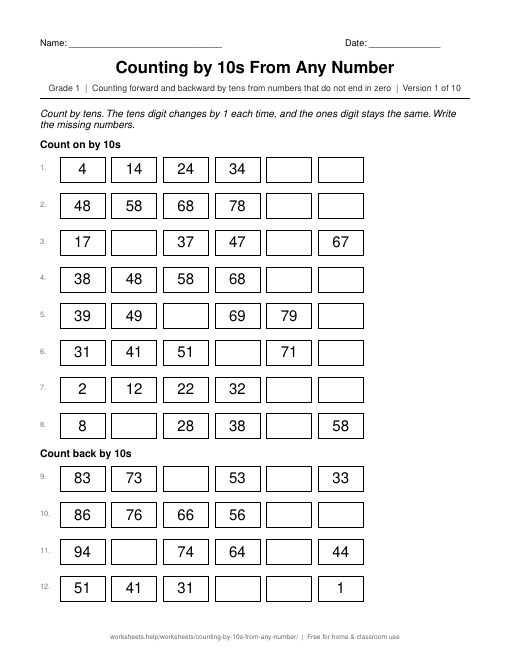
Most children learn to count by tens as 10, 20, 30. Counting by tens from a number like 27, as 27, 37, 47, is harder, and it is a big step in understanding place value. It shows that adding ten changes the tens digit and leaves the ones digit the same. This first-grade worksheet gives twelve rows of practice counting by tens from any number.
The first section has eight rows that count on by tens, starting from numbers between 1 and 49 that do not end in zero. The second section has four rows that count back by tens, starting from numbers between 51 and 99. Each row shows six numbers, and two of the boxes are empty. Children write the missing numbers. The first number is always shown, so every row has a clear place to start. Each of the ten versions has new rows and its own answer key.
How to use it: before the worksheet, count by tens together from a number like 14, using a hundred chart. Point out that each jump moves straight down one row on the chart. Then ask your child to look at the ones digit and notice that it never changes. For the rows that count back, the jump moves straight up the chart instead. If your child writes a number that is only one more, such as 15 after 14, have them say the tens and ones out loud to check.
The answer key shows every missing number. For more practice with tens, try our 10 More and 10 Less worksheet. To count by tens from zero, try our Counting to 100 by Ones and Tens worksheet.