Count by 10s and 100s From Any Number Worksheets for 2nd Grade
Download PDF worksheetAnswer key (PDF)Worksheet + answer key (2 pages)
Prints on one US Letter page; the answer key is a separate page. Print at 100% / "Actual size" on US Letter paper. Free for personal and classroom use. Version 1 of 10. Choose another version.
Skill: Skip counting by 10s and 100s within 1,000 from numbers that are not multiples of 10
Teaching tips and what to try next
Aimed at second graders who count by tens and hundreds from round numbers, as on Skip Counting by 5s, 10s and 100s. Rows that cross a new hundred, such as 392 to 402, are where most slips happen, so have children circle the hundreds digit before they begin. Single jumps are covered in 10 More, 10 Less, 100 More, 100 Less, and Counting Within 1,000: Missing Numbers gives wider range.
10 versions, each with its own answer key
Same skill and layout, a fresh set of problems in every version, so children can keep practicing without repeating a page. Problems are not repeated between versions unless a skill has only a small number of possible problems (for example, the addition facts within 10).
- Version 1: Sheet · Key · Both
- Version 2: Sheet · Key · Both
- Version 3: Sheet · Key · Both
- Version 4: Sheet · Key · Both
- Version 5: Sheet · Key · Both
- Version 6: Sheet · Key · Both
- Version 7: Sheet · Key · Both
- Version 8: Sheet · Key · Both
- Version 9: Sheet · Key · Both
- Version 10: Sheet · Key · Both
Download all 10 versions (one PDF)All 10 answer keys (PDF)
Make a new one
Want more practice? Make a brand-new Count by 10s and 100s From Any Number sheet with fresh problems and its matching answer key, created right in your browser.
Related worksheets
About this worksheet
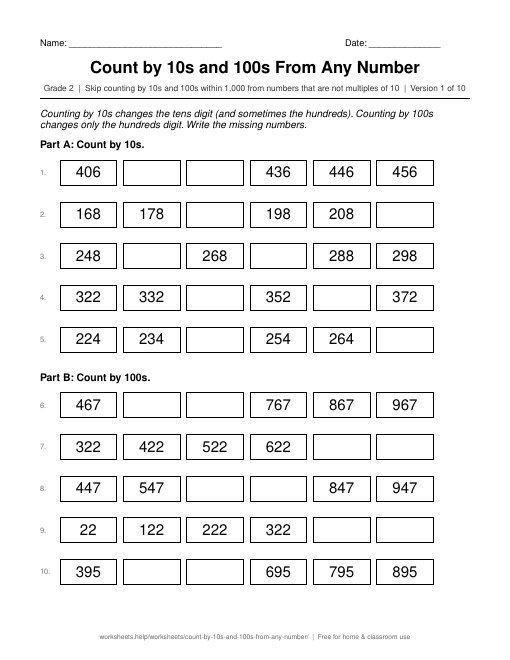
Counting by tens from 30 is easy. Counting by tens from 347, as in 347, 357, 367, is harder, and it is a great test of place value, because only the tens digit should change. Counting by hundreds from a number like 128 works the same way with the hundreds digit. Second graders skip count by 10s and 100s within 1,000, and this second-grade worksheet stretches that skill to starting numbers that do not end in zero.
The page has two parts. In Part A, five rows count by 10s from a three-digit number such as 463. Some rows cross into a new hundred, as in 386, 396, 406, which is where children most often slip. In Part B, five rows count by 100s from a starting number between 12 and 499, so only the hundreds digit changes. Each row has six boxes, and two of them are empty. The first box is always filled in, and every number stays below 1,000. Each of the ten versions has new rows and its own answer key.
How to use it: before a row, ask your child which digit will change. Have them say the tens or hundreds digit out loud as they count: "4 hundred 63, 4 hundred 73." When a row crosses a hundred, stop and talk about what happens after 9 tens. Base-ten blocks or a place value chart make the change easy to see.
The answer key shows every missing number. For whole tens and hundreds, try our Skip Counting by 5s, 10s and 100s worksheet. For one jump at a time, try our 10 More, 10 Less, 100 More, 100 Less worksheet.