Commutative Property of Multiplication Worksheets for 3rd Grade
Download PDF worksheetAnswer key (PDF)Worksheet + answer key (2 pages)
Prints on one US Letter page; the answer key is a separate page. Print at 100% / "Actual size" on US Letter paper. Free for personal and classroom use. Version 1 of 10. Choose another version.
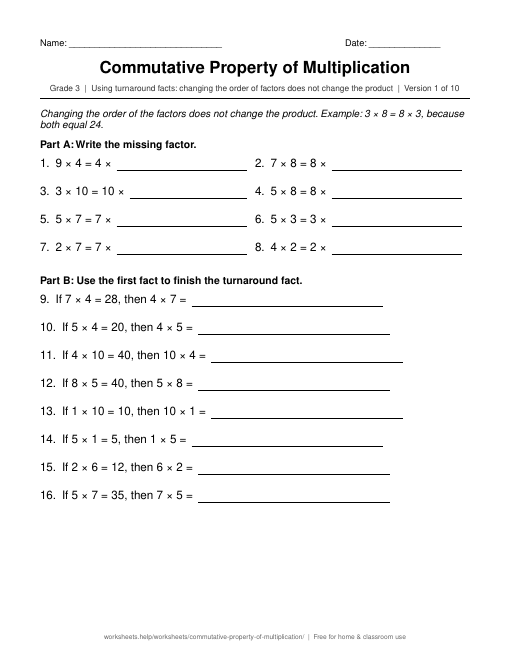
Skill: Using turnaround facts: changing the order of factors does not change the product
Teaching tips and what to try next
Made for third graders who understand multiplication as equal groups and know some facts by heart. Pair every new fact your child learns with its turnaround so both are remembered together. Arrays that show the idea are in Equal Groups Multiplication, the addition version is in Commutative Property of Addition, and the standard page is 3.OA.B.5.
10 versions, each with its own answer key
Same skill and layout, a fresh set of problems in every version, so children can keep practicing without repeating a page. Problems are not repeated between versions unless a skill has only a small number of possible problems (for example, the addition facts within 10).
- Version 1: Sheet · Key · Both
- Version 2: Sheet · Key · Both
- Version 3: Sheet · Key · Both
- Version 4: Sheet · Key · Both
- Version 5: Sheet · Key · Both
- Version 6: Sheet · Key · Both
- Version 7: Sheet · Key · Both
- Version 8: Sheet · Key · Both
- Version 9: Sheet · Key · Both
- Version 10: Sheet · Key · Both
Download all 10 versions (one PDF)All 10 answer keys (PDF)
Make a new one
Want more practice? Make a brand-new Commutative Property of Multiplication sheet with fresh problems and its matching answer key, created right in your browser.
Related worksheets
About this worksheet
Three rows of eight chairs and eight rows of three chairs hold the same number of people. That is the commutative property of multiplication: 3 × 8 and 8 × 3 have the same product. Third graders are expected to use this property as a strategy, and it cuts the number of facts to learn almost in half. This third grade worksheet helps children see and use it.
The page has two parts. Part A has eight equations such as 9 × 4 = 4 × ___, and children write the missing factor that makes both sides equal. Part B has eight problems that give a known fact, such as "If 6 × 7 = 42," and ask children to write the product of the turnaround fact, 7 × 6, without working it out again. Factors go from 1 to 10, and the two factors in a problem are always different. Each of the ten versions has new facts and its own answer key.
How to use it: draw a small array, such as 3 rows of 5 dots, then turn the page sideways so it becomes 5 rows of 3. On the sheet, remind them that the equal sign means both sides are worth the same. In Part A, a frequent mistake is writing the product on the line, so read the finished equation aloud together.
The answer key shows every missing factor and product. For turnaround facts with addition, try our Commutative Property of Addition worksheet. For seeing factors as rows and columns, try our Equal Groups Multiplication worksheet. For multiplying three factors, try our Multiplying Three Numbers worksheet.