Equal Groups Multiplication Worksheets for 3rd Grade
Download PDF worksheetAnswer key (PDF)Worksheet + answer key (2 pages)
Prints on one US Letter page; the answer key is a separate page. Print at 100% / "Actual size" on US Letter paper. Free for personal and classroom use. Version 1 of 10. Choose another version.
Skill: Writing multiplication sentences for pictures of equal groups
Teaching tips and what to try next
Made for third graders who skip count by 2s, 3s, 4s and 5s and are just meeting the × sign. Sorting a handful of coins or pasta into equal piles on the table gives your child new pictures to name. From here, build arrays in Arrays and Repeated Addition or start memorizing facts in Multiplication Facts 2-5.
10 versions, each with its own answer key
Same skill and layout, a fresh set of problems in every version, so children can keep practicing without repeating a page. Problems are not repeated between versions unless a skill has only a small number of possible problems (for example, the addition facts within 10).
- Version 1: Sheet · Key · Both
- Version 2: Sheet · Key · Both
- Version 3: Sheet · Key · Both
- Version 4: Sheet · Key · Both
- Version 5: Sheet · Key · Both
- Version 6: Sheet · Key · Both
- Version 7: Sheet · Key · Both
- Version 8: Sheet · Key · Both
- Version 9: Sheet · Key · Both
- Version 10: Sheet · Key · Both
Download all 10 versions (one PDF)All 10 answer keys (PDF)
Make a new one
Want more practice? Make a brand-new Equal Groups Multiplication sheet with fresh problems and its matching answer key, created right in your browser.
Related worksheets
About this worksheet
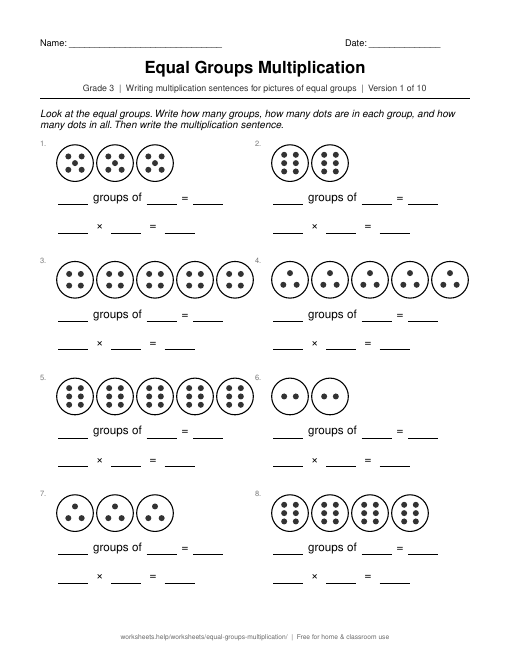
Multiplication starts with a simple idea: equal groups. Three bags with four apples in each is 3 groups of 4, or 3 × 4. Third graders who understand this picture can make sense of the times tables instead of only memorizing them. This third-grade worksheet gives eight pictures of equal groups to describe with words and with a multiplication sentence.
Each picture shows 2 to 5 circles, and every circle holds the same number of dots, from 2 to 6. Children write how many groups there are, how many dots are in each group, and how many dots there are in all. Then they write the same idea as a multiplication sentence, such as 4 × 3 = 12. The dots inside each circle are arranged in small, neat patterns, so children can see the amount in a group quickly. Each of the ten versions has new pictures and its own answer key.
How to use it: start with a hands-on example. Make three small piles of four crackers and ask your child to describe them as "3 groups of 4." Then ask for the total and how they found it. Some children will count every dot, and others will skip count, like 4, 8, 12. Both work, but skip counting is faster and leads straight to multiplication facts. Watch for children who swap the numbers in the first line; the number of circles always comes first.
The answer key shows each sentence. For a next step, try our Arrays and Repeated Addition worksheet or our Multiplication Facts 2-5 worksheet.