Adding Multiples of 10 Worksheets for 1st Grade
Download PDF worksheetAnswer key (PDF)Worksheet + answer key (2 pages)
Prints on one US Letter page; the answer key is a separate page. Print at 100% / "Actual size" on US Letter paper. Free for personal and classroom use. Version 1 of 10. Choose another version.
Skill: Adding a multiple of 10 to a two-digit number within 100
Teaching tips and what to try next
Meant for first graders who can name a two-digit number as tens and ones and count by tens without help. Sliding a finger down one row of a hundred chart for each ten added makes the jump easy to check. Then turn it around with Subtracting Multiples of 10, or add any two-digit numbers in Two-Digit Addition Without Regrouping.
10 versions, each with its own answer key
Same skill and layout, a fresh set of problems in every version, so children can keep practicing without repeating a page. Problems are not repeated between versions unless a skill has only a small number of possible problems (for example, the addition facts within 10).
- Version 1: Sheet · Key · Both
- Version 2: Sheet · Key · Both
- Version 3: Sheet · Key · Both
- Version 4: Sheet · Key · Both
- Version 5: Sheet · Key · Both
- Version 6: Sheet · Key · Both
- Version 7: Sheet · Key · Both
- Version 8: Sheet · Key · Both
- Version 9: Sheet · Key · Both
- Version 10: Sheet · Key · Both
Download all 10 versions (one PDF)All 10 answer keys (PDF)
Make a new one
Want more practice? Make a brand-new Adding Multiples of 10 sheet with fresh problems and its matching answer key, created right in your browser.
Related worksheets
About this worksheet
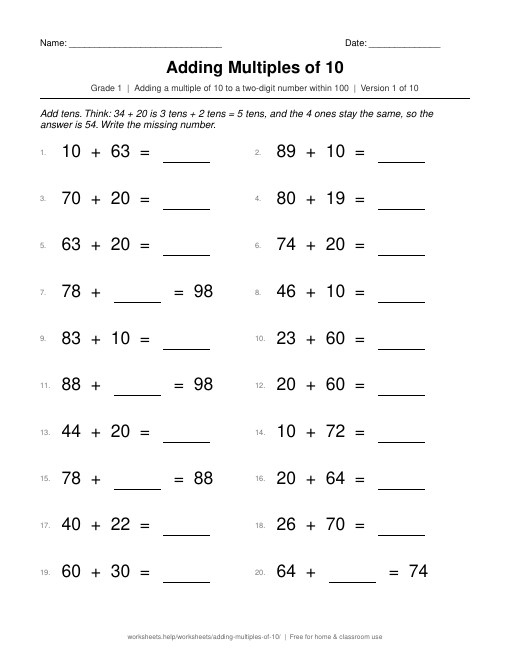
When first graders add a number like 20 to 34, they can use place value instead of counting by ones: 3 tens and 2 more tens make 5 tens, and the 4 ones stay the same. This first-grade worksheet gives twenty equations that build this mental math skill with sums up to 99.
Each equation adds a two-digit number and a multiple of 10, such as 46 + 30 or 20 + 57. The multiple of 10 can come first or second, so children learn that the order of the numbers does not change the total. Sixteen equations ask for the sum. The other four give the total and ask for the missing tens, such as 38 + ___ = 68, which gets children thinking about how many tens were added. Each of the ten versions has new equations and its own answer key.
How to use it: show one problem with base-ten blocks or with bundles of ten straws and loose ones. Add the new tens to the tens you already have, and leave the ones alone. A common mistake is to add the tens to the ones, writing 36 for 34 + 20. If that happens, say the number as tens and ones, like 3 tens and 4 ones, before adding. For the missing number problems, children can count on by tens from the first number until they reach the total.
The answer key gives every answer. For the reverse skill, try our Subtracting Multiples of 10 worksheet. To add tens and ones together, try our Two-Digit Addition With Regrouping worksheet.