Two-Digit Plus One-Digit With Regrouping Worksheets for 1st Grade
Download PDF worksheetAnswer key (PDF)Worksheet + answer key (2 pages)
Prints on one US Letter page; the answer key is a separate page. Print at 100% / "Actual size" on US Letter paper. Free for personal and classroom use. Version 1 of 10. Choose another version.
Skill: Two-digit plus one-digit addition that makes a new ten
Teaching tips and what to try next
Fits first graders who add within 20 using a make-ten strategy, as in Make a Ten to Add. Ask your child how many the top number needs to reach the next ten, then add what is left; 47 + 8 becomes 47 + 3 + 5. After this, two-digit plus two-digit sums follow in Two-Digit Addition With Regrouping.
10 versions, each with its own answer key
Same skill and layout, a fresh set of problems in every version, so children can keep practicing without repeating a page. Problems are not repeated between versions unless a skill has only a small number of possible problems (for example, the addition facts within 10).
- Version 1: Sheet · Key · Both
- Version 2: Sheet · Key · Both
- Version 3: Sheet · Key · Both
- Version 4: Sheet · Key · Both
- Version 5: Sheet · Key · Both
- Version 6: Sheet · Key · Both
- Version 7: Sheet · Key · Both
- Version 8: Sheet · Key · Both
- Version 9: Sheet · Key · Both
- Version 10: Sheet · Key · Both
Download all 10 versions (one PDF)All 10 answer keys (PDF)
Make a new one
Want more practice? Make a brand-new Two-Digit Plus One-Digit With Regrouping sheet with fresh problems and its matching answer key, created right in your browser.
Related worksheets
About this worksheet
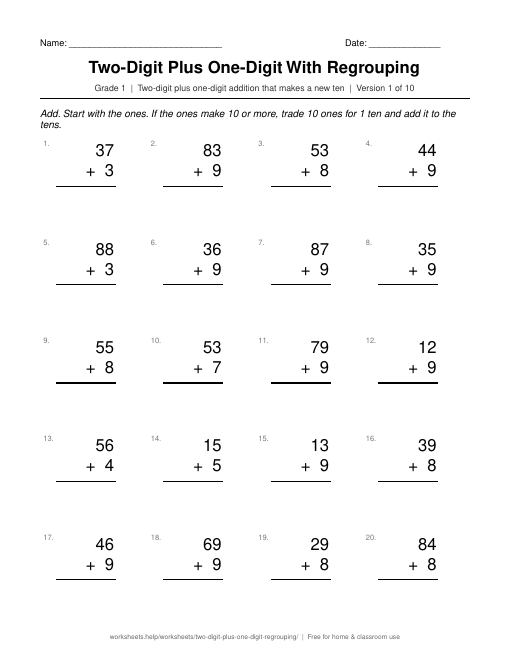
In first grade, children learn to add a one-digit number to a two-digit number, and the tricky part is when the ones make a new ten, as in 47 + 8. This first-grade worksheet gives twenty vertical problems where the ones always add up to 10 or more, so every problem needs regrouping.
Each problem has a two-digit number from 11 to 89 on top and a one-digit number from 2 to 9 below it. The ones digit on top is never 0, and every sum stays below 100. Some answers land right on a ten, like 37 + 3 = 40, which shows children what happens when the ones make exactly ten. Each of the ten versions has new problems and its own answer key.
How to use it: show one problem with base-ten blocks or with bundles of ten straws. Add the ones first. When there are ten or more loose ones, bundle ten of them into a new ten and move it to the tens column. Then count the tens. Many children forget the extra ten and write 45 instead of 55 for 47 + 8, so ask "Did you make a new ten?" after each answer. A quick check is to count on from the bigger number with fingers.
The answer key shows every sum. If your child needs practice without regrouping first, try our Two-Digit Addition Without Regrouping worksheet. For the next step, try our Two-Digit Addition With Regrouping worksheet.