Two-Digit Addition Without Regrouping Worksheets for 1st Grade
Download PDF worksheetAnswer key (PDF)Worksheet + answer key (2 pages)
Prints on one US Letter page; the answer key is a separate page. Print at 100% / "Actual size" on US Letter paper. Free for personal and classroom use. Version 1 of 10. Choose another version.
Skill: Adding within 100 without regrouping, using tens and ones
Teaching tips and what to try next
Adding tens to tens and ones to ones prepares children for regrouping, so make sure they line up the digits and start with the ones. Base-ten blocks or a quick sketch of tens (lines) and ones (dots) help children who mix up the columns. When this is easy, move on to Two-Digit Addition With Regrouping (2nd grade).
10 versions, each with its own answer key
Same skill and layout, a fresh set of problems in every version, so children can keep practicing without repeating a page. Problems are not repeated between versions unless a skill has only a small number of possible problems (for example, the addition facts within 10).
- Version 1: Sheet · Key · Both
- Version 2: Sheet · Key · Both
- Version 3: Sheet · Key · Both
- Version 4: Sheet · Key · Both
- Version 5: Sheet · Key · Both
- Version 6: Sheet · Key · Both
- Version 7: Sheet · Key · Both
- Version 8: Sheet · Key · Both
- Version 9: Sheet · Key · Both
- Version 10: Sheet · Key · Both
Download all 10 versions (one PDF)All 10 answer keys (PDF)
Make a new one
Want more practice? Make a brand-new Two-Digit Addition Without Regrouping sheet with fresh problems and its matching answer key, created right in your browser.
Related worksheets
About this worksheet
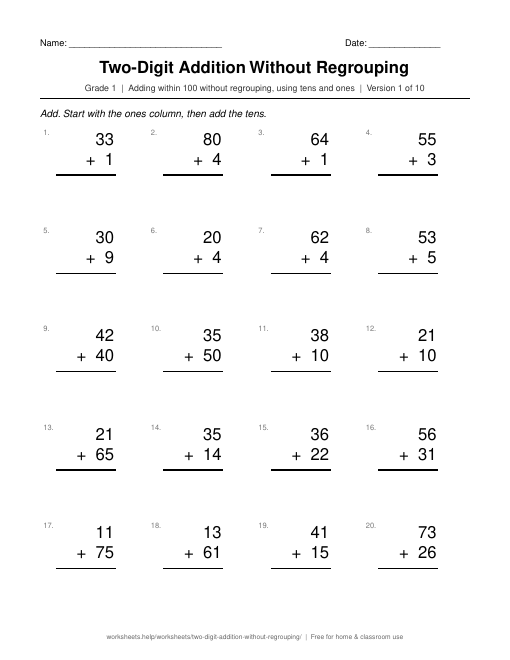
Before children learn to carry, they need to see that adding two-digit numbers is just adding ones to ones and tens to tens. This first-grade worksheet gives twenty vertical addition problems where no column ever adds up to 10 or more, so the focus stays on place value instead of regrouping.
The problems build in three steps. The first eight add a two-digit number and a one-digit number, such as 34 + 5, so only the ones change. The next four add a multiple of ten, such as 42 + 30, so only the tens change. The last eight add two two-digit numbers, such as 36 + 22, where children add the ones column and then the tens column. The ten versions each have a new set of problems.
How to use it: remind your child to always start with the ones column on the right. Base-ten blocks, or drawings of sticks for tens and dots for ones, make the idea concrete: 36 + 22 is three sticks and six dots plus two sticks and two dots. For the multiples of ten, ask, "What happens to the ones when we add 30?" Children who finish quickly can check each answer by counting on with a hundred chart.
The answer key lists every sum. This worksheet supports Common Core standard 1.NBT.C.4. When your child is confident, try our Two-Digit Addition With Regrouping worksheet. For fact fluency, practice with our Addition Within 20 worksheet.