Subtracting Multiples of 10 Worksheets for 1st Grade
Download PDF worksheetAnswer key (PDF)Worksheet + answer key (2 pages)
Prints on one US Letter page; the answer key is a separate page. Print at 100% / "Actual size" on US Letter paper. Free for personal and classroom use. Version 1 of 10. Choose another version.
Skill: Subtracting multiples of 10 from multiples of 10 within 90
Teaching tips and what to try next
Works well for first graders who count by tens to 100 and can tell how many tens are in 60. A handful of dimes is a handy model, since each coin is worth ten and taking some away is easy to see. Pair it with 10 More and 10 Less, then move to two-digit numbers in Two-Digit Subtraction Without Regrouping; the standard is at 1.NBT.C.6.
10 versions, each with its own answer key
Same skill and layout, a fresh set of problems in every version, so children can keep practicing without repeating a page. Problems are not repeated between versions unless a skill has only a small number of possible problems (for example, the addition facts within 10).
- Version 1: Sheet · Key · Both
- Version 2: Sheet · Key · Both
- Version 3: Sheet · Key · Both
- Version 4: Sheet · Key · Both
- Version 5: Sheet · Key · Both
- Version 6: Sheet · Key · Both
- Version 7: Sheet · Key · Both
- Version 8: Sheet · Key · Both
- Version 9: Sheet · Key · Both
- Version 10: Sheet · Key · Both
Download all 10 versions (one PDF)All 10 answer keys (PDF)
Make a new one
Want more practice? Make a brand-new Subtracting Multiples of 10 sheet with fresh problems and its matching answer key, created right in your browser.
Related worksheets
About this worksheet
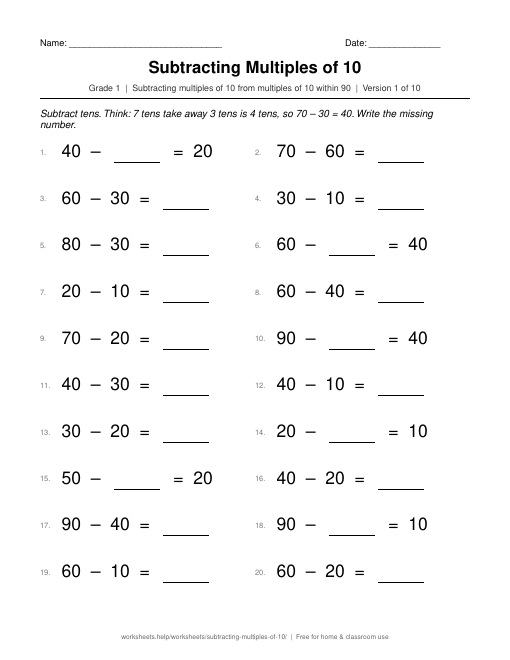
When first graders understand that 70 is seven tens, subtracting 30 becomes easy: seven tens take away three tens leaves four tens, or 40. This first-grade worksheet builds that place-value thinking with twenty subtraction equations that use only multiples of 10.
Every number on the page is a multiple of 10 from 10 to 90, and every answer is 10 or more. Fourteen equations ask for the difference, such as 80 – 50 = ___. Six equations ask for the missing number being taken away, such as 60 – ___ = 20, which makes children think about how many tens are needed to get from one number to the other. The two kinds are mixed together on the page. There are only 36 possible pairs, so the ten versions use every pair before any repeats, each in a new order with its own answer key.
How to use it: before starting, count by tens together and show that 50 means five tens. Bundles of ten sticks or ten-frame cards make the idea concrete: take away the right number of bundles and count what is left. Ask your child to say each problem with tens, like "eight tens minus five tens," and then turn the answer back into a number. For the missing-number problems, counting up by tens from the answer to the first number also works.
The answer key shows every missing number. For adding and subtracting tens with other numbers, try our 10 More and 10 Less worksheet.