Complete Sentences, Fragments, and Run-Ons
Home › 4th Grade › Reading & Writing
Download PDF worksheetAnswer key (PDF)Worksheet + answer key (2 pages)
Prints on one US Letter page; the answer key is a separate page. Print at 100% / "Actual size" on US Letter paper. Free for personal and classroom use.
Skill: Telling complete sentences from fragments and run-on sentences
Related worksheets
About this worksheet
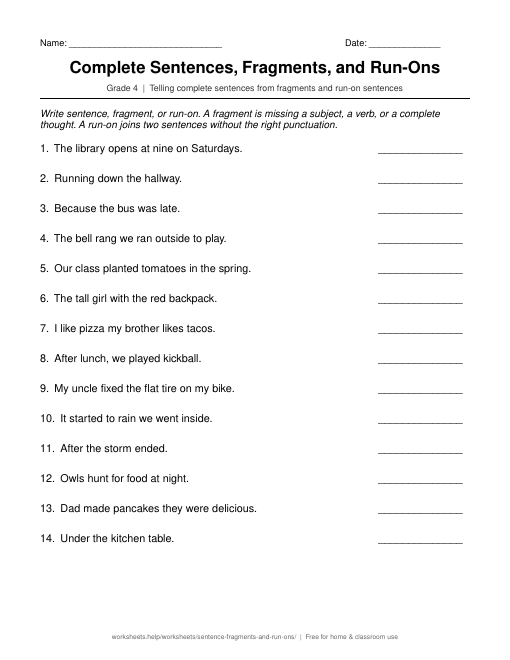
A complete sentence has a subject and a verb and expresses a complete thought. Two common writing mistakes break this rule. A fragment is only part of a sentence, such as "Because the bus was late." A run-on is two sentences joined without the right punctuation, such as "The bell rang we ran outside." This fourth-grade worksheet helps students tell the three apart.
The sheet has fourteen short examples in mixed order: five complete sentences, five fragments, and four run-ons. Students read each one and write sentence, fragment, or run-on on the line. The fragments include the most common kinds students write, such as a phrase starting with because or after, a phrase with no verb, and an -ing phrase with no subject. The run-ons are short, everyday sentences, so students can focus on finding where one thought ends and the next begins.
How to use it: for each example, ask two questions. "Who or what is this about?" finds the subject. "Is it a complete thought?" tells whether the reader is left waiting for more. Reading aloud helps a lot, because a run-on usually sounds like it needs a pause in the middle. As an extension, have students fix each fragment by adding the missing part and fix each run-on with a period, or with a comma and a word such as and, but, or so.
The answer key lists the correct label for every example. This worksheet supports Common Core standard L.4.1.f (produce complete sentences, recognizing and correcting inappropriate fragments and run-ons). Pair it with our Homophones worksheet for more fourth-grade grammar, and review our Subject-Verb Agreement worksheet.