Multiplying Fractions by Whole Numbers Worksheets for 4th Grade
Download PDF worksheetAnswer key (PDF)Worksheet + answer key (2 pages)
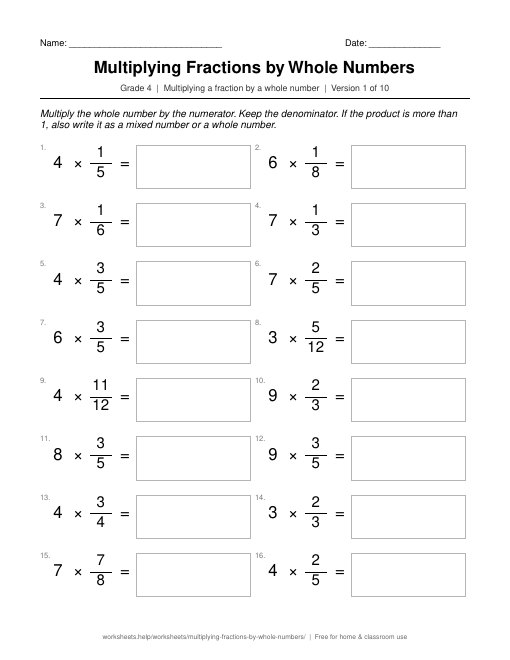
Prints on one US Letter page; the answer key is a separate page. Print at 100% / "Actual size" on US Letter paper. Free for personal and classroom use. Version 1 of 10. Choose another version.
Skill: Multiplying a fraction by a whole number
Teaching tips and what to try next
3 x 2/5 means three groups of 2/5, so it equals 6/5. Have your child draw the groups before multiplying the numerator. Next, try Multiplying Fractions (5th grade), or Improper Fractions and Mixed Numbers to rewrite answers.
10 versions, each with its own answer key
Same skill and layout, a fresh set of problems in every version, so children can keep practicing without repeating a page. Problems are not repeated between versions unless a skill has only a small number of possible problems (for example, the addition facts within 10).
- Version 1: Sheet · Key · Both
- Version 2: Sheet · Key · Both
- Version 3: Sheet · Key · Both
- Version 4: Sheet · Key · Both
- Version 5: Sheet · Key · Both
- Version 6: Sheet · Key · Both
- Version 7: Sheet · Key · Both
- Version 8: Sheet · Key · Both
- Version 9: Sheet · Key · Both
- Version 10: Sheet · Key · Both
Download all 10 versions (one PDF)All 10 answer keys (PDF)
Make a new one
Want more practice? Make a brand-new Multiplying Fractions by Whole Numbers sheet with fresh problems and its matching answer key, created right in your browser.
Related worksheets
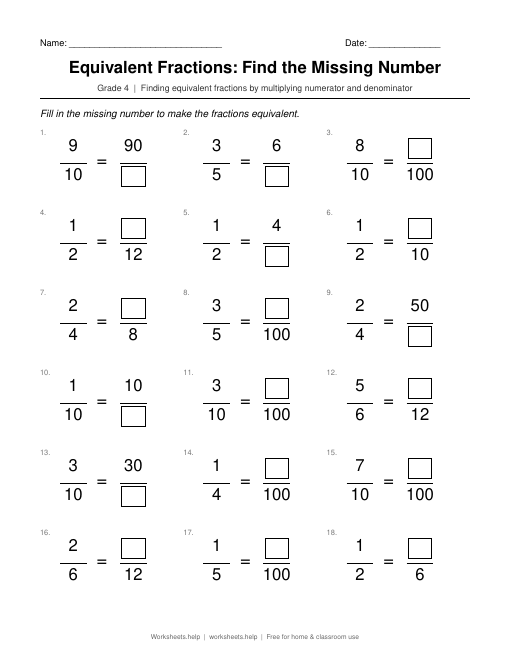 Equivalent Fractions: Find the Missing Number
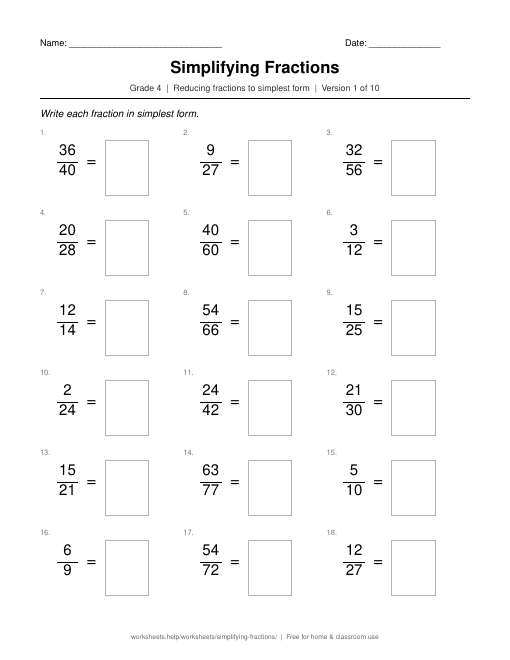 Simplifying Fractions
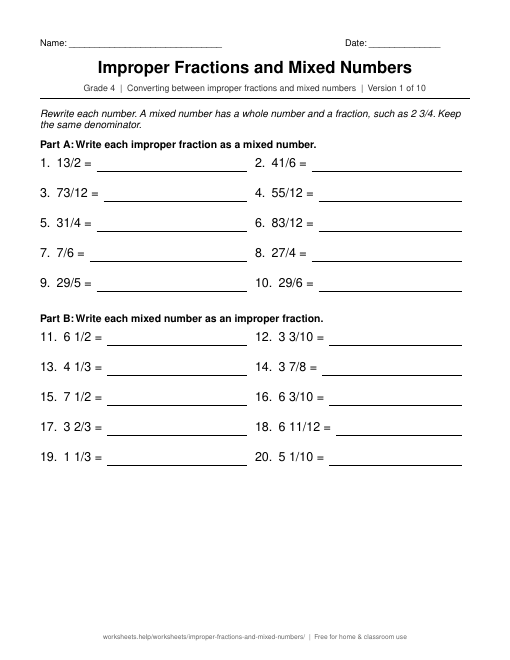 Improper Fractions and Mixed Numbers
About this worksheet
Multiplying a fraction by a whole number is the same as adding the fraction again and again. For example, 3 × 2/5 means 2/5 + 2/5 + 2/5, which is 6/5. This fourth-grade worksheet gives sixteen problems that build this idea step by step.
The first four problems multiply a whole number by a unit fraction, such as 4 × 1/6, so students see that the answer is simply 4 sixths. The rest use fractions such as 3/4, 5/8, and 7/10, with denominators up to 12. Students multiply the whole number by the numerator, keep the denominator, and when the product is more than 1, also write it as a mixed number or a whole number. The ten versions never repeat a problem.
How to use it: draw a quick model for the first few problems. For 3 × 2/5, draw three bars cut into fifths and shade two parts of each, then count the shaded fifths. The denominator stays the same because the size of the pieces does not change; only the number of pieces does. To turn 13/4 into a mixed number, ask how many groups of 4 fourths fit in 13 fourths. The answer key also shows the simplest form, such as 1 3/12 = 1 1/4, for students who are ready to simplify.
The answer key lists every product as a fraction, then as a mixed or whole number. This worksheet supports Common Core standards 4.NF.B.4.a and 4.NF.B.4.b (understand a fraction a/b as a multiple of 1/b and multiply a fraction by a whole number). Review with our Improper Fractions and Mixed Numbers worksheet and our Equivalent Fractions worksheet.