Simplifying Fractions
Download PDF worksheetAnswer key (PDF)Worksheet + answer key (2 pages)
Prints on one US Letter page; the answer key is a separate page. Print at 100% / "Actual size" on US Letter paper. Free for personal and classroom use. Version 1 of 10. Choose another version.
Skill: Reducing fractions to simplest form
10 versions, each with its own answer key
Same skill and layout, a fresh set of problems in every version, so children can keep practicing without repeating a page. Problems are not repeated between versions unless a skill has only a small number of possible problems (for example, the addition facts within 10).
- Version 1: Sheet · Key · Both
- Version 2: Sheet · Key · Both
- Version 3: Sheet · Key · Both
- Version 4: Sheet · Key · Both
- Version 5: Sheet · Key · Both
- Version 6: Sheet · Key · Both
- Version 7: Sheet · Key · Both
- Version 8: Sheet · Key · Both
- Version 9: Sheet · Key · Both
- Version 10: Sheet · Key · Both
Download all 10 versions (one PDF)All 10 answer keys (PDF)
Make a new one
Want more practice? Make a brand-new Simplifying Fractions sheet with fresh problems and its matching answer key, created right in your browser.
About this worksheet
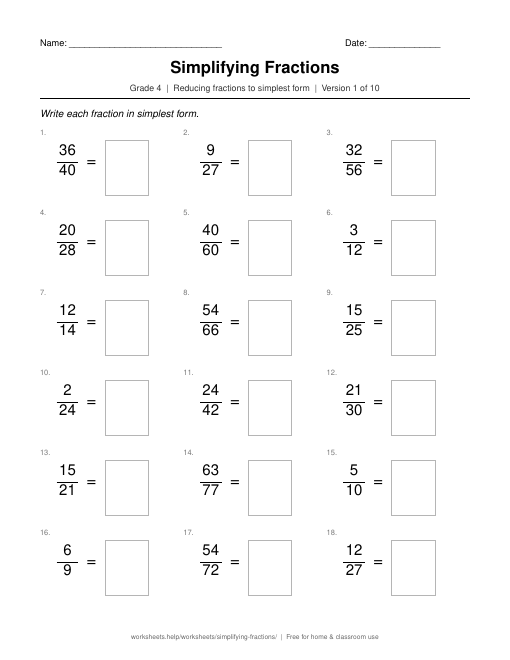
A fraction is in simplest form when its numerator and denominator share no common factor other than 1. Simplifying, also called reducing, helps students compare fractions, add unlike fractions, and recognize equivalent forms. This fourth-grade worksheet gives eighteen proper fractions that are not yet in simplest form. Students write each fraction in lowest terms, such as rewriting 6/8 as 3/4.
Every starting fraction has a greatest common factor greater than 1, so students must actually divide. Denominators stay within a friendly grade 4 range so the arithmetic does not overshadow the simplifying idea.
How to use it: teach students to find the greatest common factor of the numerator and denominator, then divide both by that number. Listing factors or using divisibility rules for 2, 3, and 5 speeds the work. Check by confirming that the new numerator and denominator share no common factor. Cross-canceling later multiplication problems rests on this same skill.
The answer key lists every simplified fraction. This worksheet supports Common Core standard 4.NF.A.1 (explain why a fraction a/b is equivalent to a fraction (n × a)/(n × b) by using visual fraction models, with attention to how the number and size of the parts differ even though the two fractions themselves are the same size). Use it after our Equivalent Fractions worksheet.