Ordering Decimals Worksheets for 5th Grade
Download PDF worksheetAnswer key (PDF)Worksheet + answer key (2 pages)
Prints on one US Letter page; the answer key is a separate page. Print at 100% / "Actual size" on US Letter paper. Free for personal and classroom use. Version 1 of 10. Choose another version.
Skill: Putting decimals to thousandths in order
Teaching tips and what to try next
Fits fifth graders who can compare two decimals with confidence, so start with Comparing Decimals to Thousandths if that is still shaky. Writing every number with three decimal places in a column, lined up by the point, turns the task into ordering whole numbers. Then practice place names in Reading and Writing Decimals to Thousandths.
10 versions, each with its own answer key
Same skill and layout, a fresh set of problems in every version, so children can keep practicing without repeating a page. Problems are not repeated between versions unless a skill has only a small number of possible problems (for example, the addition facts within 10).
- Version 1: Sheet · Key · Both
- Version 2: Sheet · Key · Both
- Version 3: Sheet · Key · Both
- Version 4: Sheet · Key · Both
- Version 5: Sheet · Key · Both
- Version 6: Sheet · Key · Both
- Version 7: Sheet · Key · Both
- Version 8: Sheet · Key · Both
- Version 9: Sheet · Key · Both
- Version 10: Sheet · Key · Both
Download all 10 versions (one PDF)All 10 answer keys (PDF)
Make a new one
Want more practice? Make a brand-new Ordering Decimals sheet with fresh problems and its matching answer key, created right in your browser.
Related worksheets
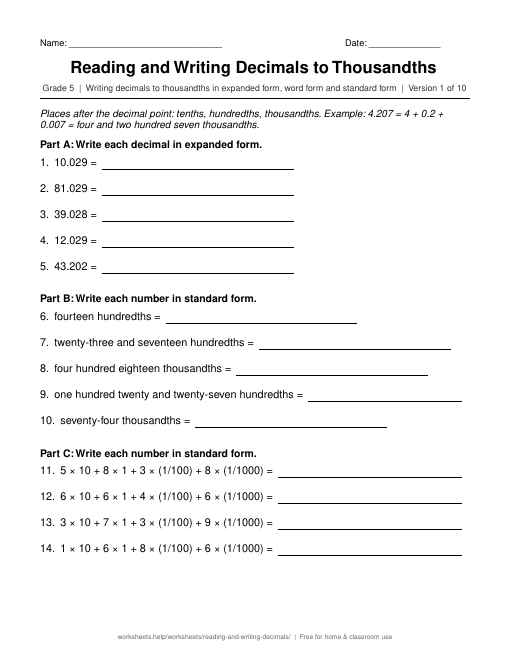 Reading and Writing Decimals to Thousandths
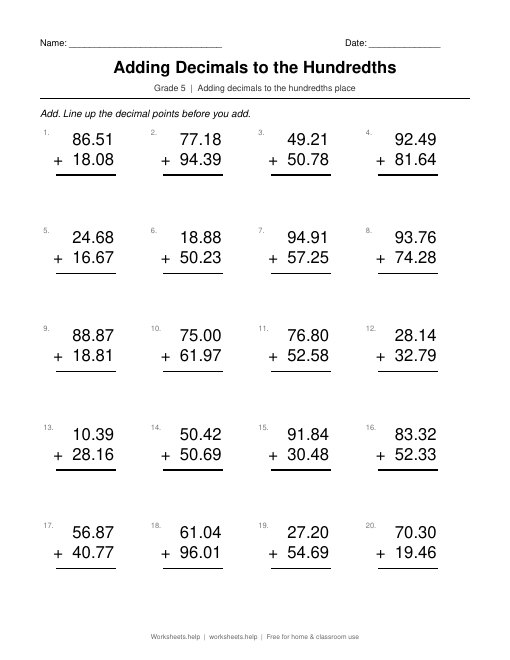 Adding Decimals to the Hundredths
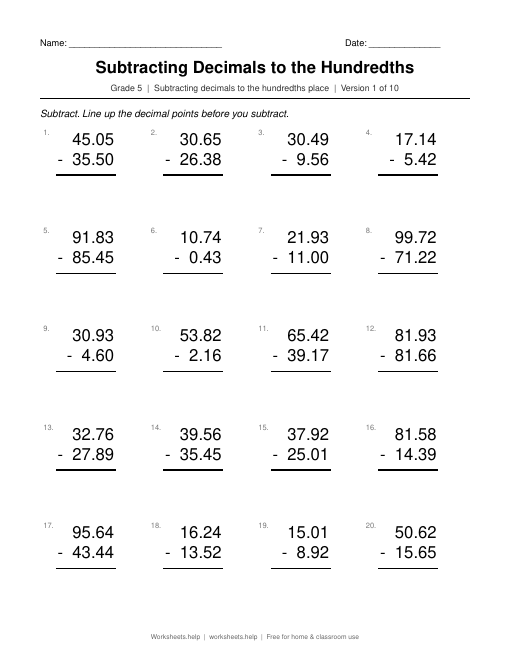 Subtracting Decimals to the Hundredths
About this worksheet
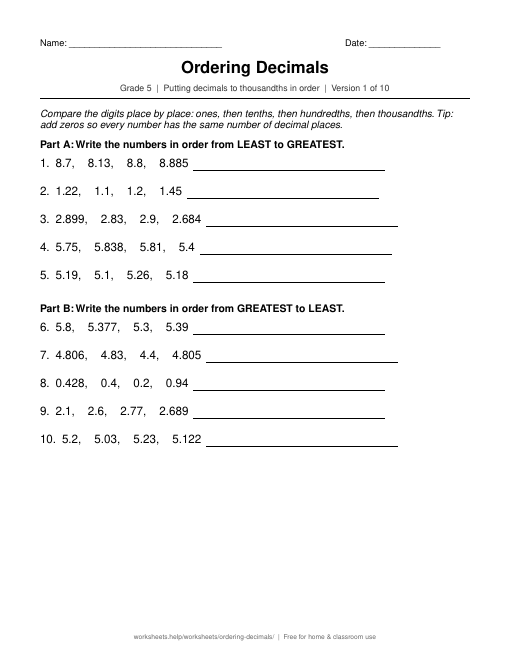
Putting decimals in order is a little harder than comparing just two, because students must keep several numbers in mind at once. This fifth-grade worksheet gives ten sets of four decimals. In Part A, students write each set in order from least to greatest, and in Part B, from greatest to least.
All four numbers in a set have the same whole-number part, so the decimal digits decide the order. The numbers are written with one, two, or three decimal places, such as 4.4, 4.83, and 4.806, and at least two numbers in every set share the same tenths digit. That means students often need to look past the tenths to the hundredths or thousandths. The mix of lengths also tests a common mistake: thinking that a number with more digits, like 4.806, must be greater than a shorter one, like 4.83. Each of the ten versions has new sets and its own answer key.
How to use it: show your student how to line the numbers up by their decimal points and add zeros to the end so that every number has three decimal places. Then the numbers can be compared like whole numbers: 4.400, 4.830, 4.806. Cross out each number after writing it in the answer, so none is missed or used twice. Have your student read the final order out loud as a check.
The answer key shows every set in the correct order. To compare two decimals at a time, try our Comparing Decimals to Thousandths worksheet. To review place names, try our Reading and Writing Decimals to Thousandths worksheet.