Arrays and Repeated Addition
Download PDF worksheetAnswer key (PDF)Worksheet + answer key (2 pages)
Prints on one US Letter page; the answer key is a separate page. Print at 100% / "Actual size" on US Letter paper. Free for personal and classroom use. Version 1 of 10. Choose another version.
Skill: Writing repeated addition equations for arrays
10 versions, each with its own answer key
Same skill and layout, a fresh set of problems in every version, so children can keep practicing without repeating a page. Problems are not repeated between versions unless a skill has only a small number of possible problems (for example, the addition facts within 10).
- Version 1: Sheet · Key · Both
- Version 2: Sheet · Key · Both
- Version 3: Sheet · Key · Both
- Version 4: Sheet · Key · Both
- Version 5: Sheet · Key · Both
- Version 6: Sheet · Key · Both
- Version 7: Sheet · Key · Both
- Version 8: Sheet · Key · Both
- Version 9: Sheet · Key · Both
- Version 10: Sheet · Key · Both
Download all 10 versions (one PDF)All 10 answer keys (PDF)
Make a new one
Want more practice? Make a brand-new Arrays and Repeated Addition sheet with fresh problems and its matching answer key, created right in your browser.
Related worksheets
About this worksheet
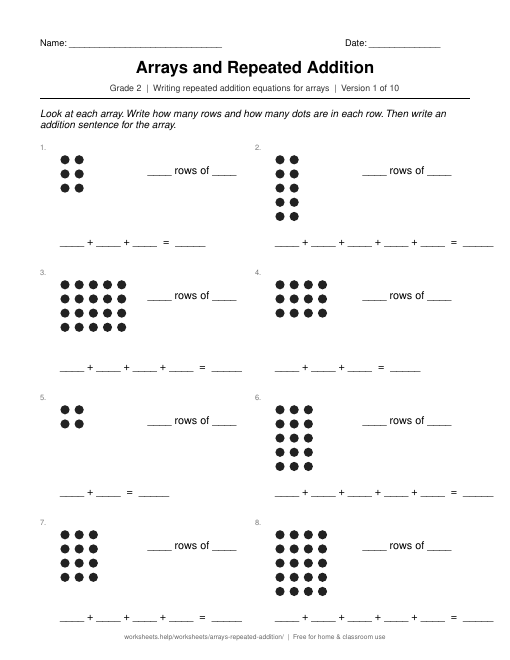
An array is a set of objects arranged in equal rows and columns, like eggs in a carton or chairs in a classroom. Arrays help second graders see that adding the same number again and again is a quick way to count. They are also the first step toward multiplication. This second-grade worksheet shows eight dot arrays, each with 2 to 5 rows and 2 to 5 columns.
For each array, students write how many rows there are and how many dots are in each row. Then they write a repeated addition equation that matches, such as 4 + 4 + 4 = 12 for three rows of four. Every array is a rectangle up to 5 by 5, which matches the second-grade standard. The ten versions use all sixteen possible arrays before any repeat.
How to use it: build a small array with coins or blocks first. Count the rows, then count the dots in one row. Point to each row as you say the addends out loud: "four, plus four, plus four." Then count all the dots to check the total. Students can also turn the paper sideways and notice that three rows of four becomes four rows of three, with the same total.
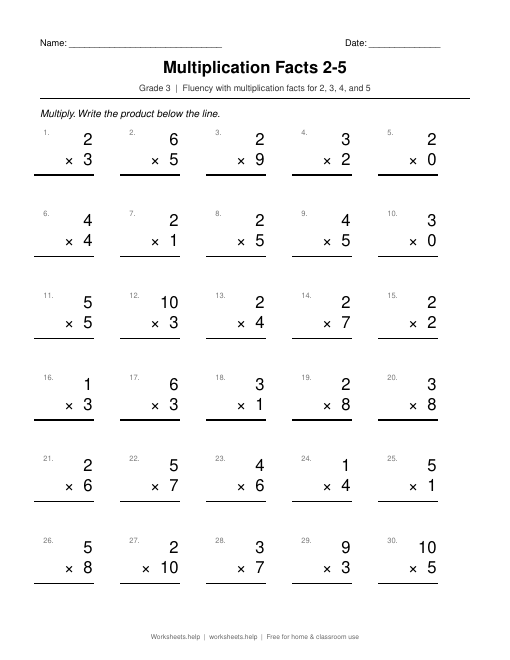
The answer key lists the rows, the dots in each row, and the full equation for every array. This worksheet supports Common Core standard 2.OA.C.4 (use addition to find the total number of objects arranged in rectangular arrays with up to 5 rows and up to 5 columns). Try our Skip Counting by 5s, 10s, 100s worksheet next, and look ahead to our Multiplication Facts 2-5 worksheet.