Doubles Facts to 20 Worksheets for 1st Grade
Download PDF worksheetAnswer key (PDF)Worksheet + answer key (2 pages)
Prints on one US Letter page; the answer key is a separate page. Print at 100% / "Actual size" on US Letter paper. Free for personal and classroom use. Version 1 of 10. Choose another version.
Skill: Adding doubles from 1 + 1 to 10 + 10 and using them to subtract
Teaching tips and what to try next
A good fit for first graders who add within 10 with some confidence and are starting facts with teen totals. A mirror is a handy prop: hold it beside a few counters and the reflection shows the other half of the double. When these come quickly, try Doubles and Near Doubles Addition or the fact family view in Fact Families Within 20.
10 versions, each with its own answer key
Same skill and layout, a fresh set of problems in every version, so children can keep practicing without repeating a page. Problems are not repeated between versions unless a skill has only a small number of possible problems (for example, the addition facts within 10).
- Version 1: Sheet · Key · Both
- Version 2: Sheet · Key · Both
- Version 3: Sheet · Key · Both
- Version 4: Sheet · Key · Both
- Version 5: Sheet · Key · Both
- Version 6: Sheet · Key · Both
- Version 7: Sheet · Key · Both
- Version 8: Sheet · Key · Both
- Version 9: Sheet · Key · Both
- Version 10: Sheet · Key · Both
Download all 10 versions (one PDF)All 10 answer keys (PDF)
Make a new one
Want more practice? Make a brand-new Doubles Facts to 20 sheet with fresh problems and its matching answer key, created right in your browser.
Related worksheets
About this worksheet
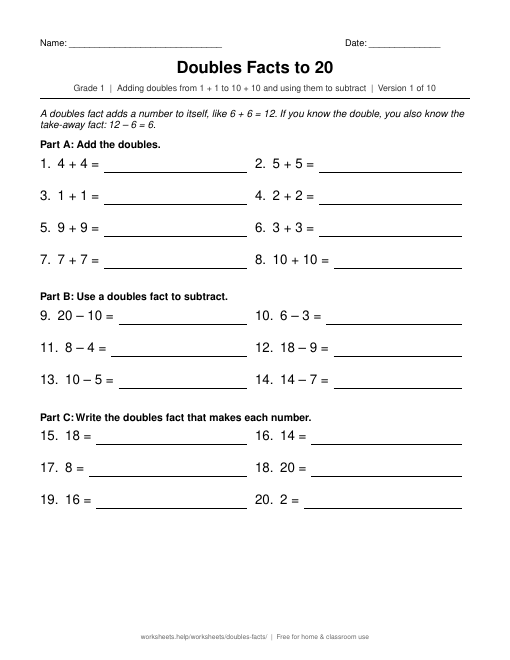
Doubles facts, such as 6 + 6 and 8 + 8, are some of the easiest facts for children to remember. Once a child knows that 7 + 7 is 14, they can also find 14 take away 7 and work out near doubles like 7 + 8. First graders are expected to use strategies like this to add and subtract within 20. This first-grade worksheet practices the doubles from 1 + 1 to 10 + 10 in three ways.
Part A has eight doubles to add. Part B has six subtraction facts that undo a double, such as 16 – 8, so children can use the doubles fact they know to find the answer. Part C turns things around: children see an even number, such as 12, and write the doubles fact that makes it. Every fact uses numbers from 1 to 10. Each of the ten versions has a new mix of facts and its own answer key.
How to use it: doubles are easy to picture, so start with real things. Two hands make 5 + 5, an egg carton shows 6 + 6, and a pair of dice can show any double up to 6 + 6. Ask your child to say each fact out loud as they write it. For Part B, ask what double has 16 as its total. That turns subtraction into a fact they already know.
The answer key gives every answer. For the next step, try our Doubles and Near Doubles Addition worksheet. For another strategy, try our Make a Ten to Add worksheet.