Division Facts Mixed 1-10 Worksheets for 3rd Grade
Download PDF worksheetAnswer key (PDF)Worksheet + answer key (2 pages)
Prints on one US Letter page; the answer key is a separate page. Print at 100% / "Actual size" on US Letter paper. Free for personal and classroom use. Version 1 of 10. Choose another version.
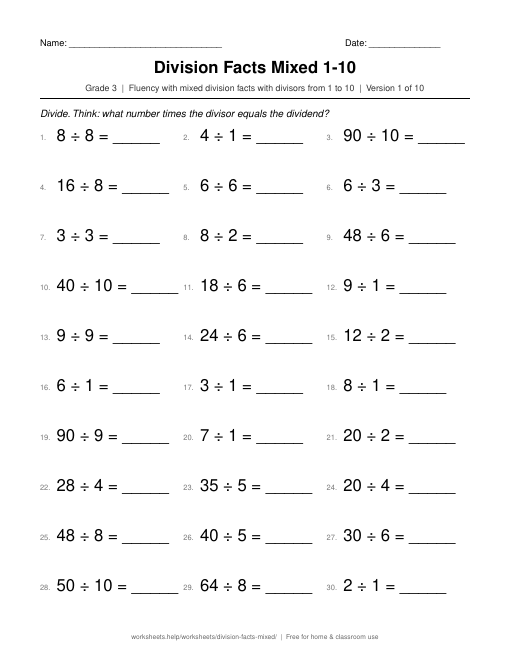
Skill: Fluency with mixed division facts with divisors from 1 to 10
Teaching tips and what to try next
Works for third graders who know most multiplication facts and have started division bands such as Division Facts 2-5. Asking "times what equals this number?" turns each problem into a known fact. Mixed multiplication review pairs well in Multiplication Facts Mixed 0-10.
10 versions, each with its own answer key
Same skill and layout, a fresh set of problems in every version, so children can keep practicing without repeating a page. Problems are not repeated between versions unless a skill has only a small number of possible problems (for example, the addition facts within 10).
- Version 1: Sheet · Key · Both
- Version 2: Sheet · Key · Both
- Version 3: Sheet · Key · Both
- Version 4: Sheet · Key · Both
- Version 5: Sheet · Key · Both
- Version 6: Sheet · Key · Both
- Version 7: Sheet · Key · Both
- Version 8: Sheet · Key · Both
- Version 9: Sheet · Key · Both
- Version 10: Sheet · Key · Both
Download all 10 versions (one PDF)All 10 answer keys (PDF)
Make a new one
Want more practice? Make a brand-new Division Facts Mixed 1-10 sheet with fresh problems and its matching answer key, created right in your browser.
Related worksheets
About this worksheet
Division facts feel easier when children see them as missing-factor questions. To solve 42 divided by 6, ask "6 times what is 42?" Third graders are expected to fluently divide within 100, and mixed practice across all the divisors from 1 to 10 builds that fluency after the smaller bands are solid.
The page has thirty division problems. Divisors run from 1 to 10, and quotients also run from 1 to 10, so every basic fact in that range can appear. The problems are mixed rather than grouped by divisor, which stops children from coasting on a single pattern. Each of the ten versions has a new set of facts and its own answer key.
How to use it: encourage the "times what" question out loud for any fact that stalls. If your child knows 6 times 7 is 42, the matching division fact should follow. Keep a multiplication chart nearby for the first pass, then hide it and retry the ones that needed a peek.
The answer key shows every quotient. For smaller bands, try our Division Facts 2-5 worksheet and our Division Facts 6-9 worksheet. For mixed multiplication practice that pairs with this page, try our Multiplication Facts Mixed 0-10 worksheet.