Comparing Fractions With the Same Numerator or Denominator Worksheets for 3rd Grade
Download PDF worksheetAnswer key (PDF)Worksheet + answer key (2 pages)
Prints on one US Letter page; the answer key is a separate page. Print at 100% / "Actual size" on US Letter paper. Free for personal and classroom use. Version 1 of 10. Choose another version.
Skill: Comparing two fractions that have the same numerator or the same denominator
Teaching tips and what to try next
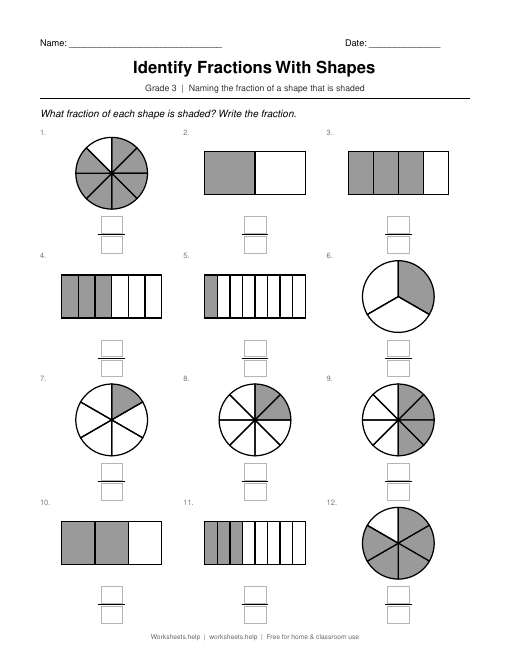
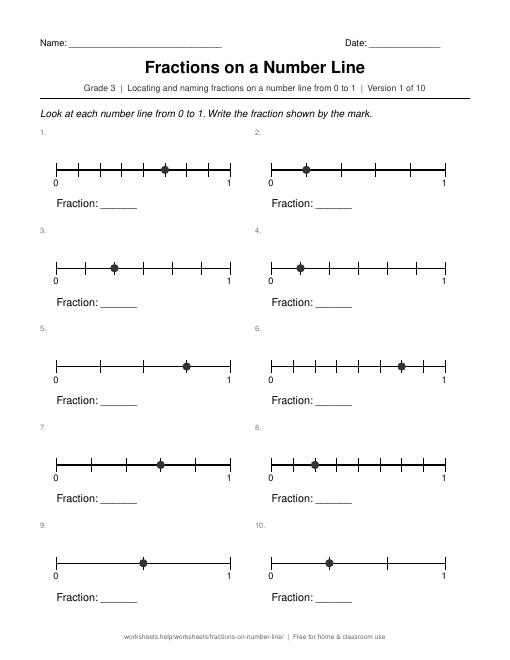
This fits third graders who can already name fractions from pictures and place them on a number line. When numerators match, ask which piece is bigger, a third or a sixth, and fold paper strips to check. Build the picture sense first with Identify Fractions With Shapes or Fractions on a Number Line; when your child is ready for unlike denominators, try Comparing Fractions With Different Denominators.
10 versions, each with its own answer key
Same skill and layout, a fresh set of problems in every version, so children can keep practicing without repeating a page. Problems are not repeated between versions unless a skill has only a small number of possible problems (for example, the addition facts within 10).
- Version 1: Sheet · Key · Both
- Version 2: Sheet · Key · Both
- Version 3: Sheet · Key · Both
- Version 4: Sheet · Key · Both
- Version 5: Sheet · Key · Both
- Version 6: Sheet · Key · Both
- Version 7: Sheet · Key · Both
- Version 8: Sheet · Key · Both
- Version 9: Sheet · Key · Both
- Version 10: Sheet · Key · Both
Download all 10 versions (one PDF)All 10 answer keys (PDF)
Make a new one
Want more practice? Make a brand-new Comparing Fractions With the Same Numerator or Denominator sheet with fresh problems and its matching answer key, created right in your browser.
Related worksheets
About this worksheet
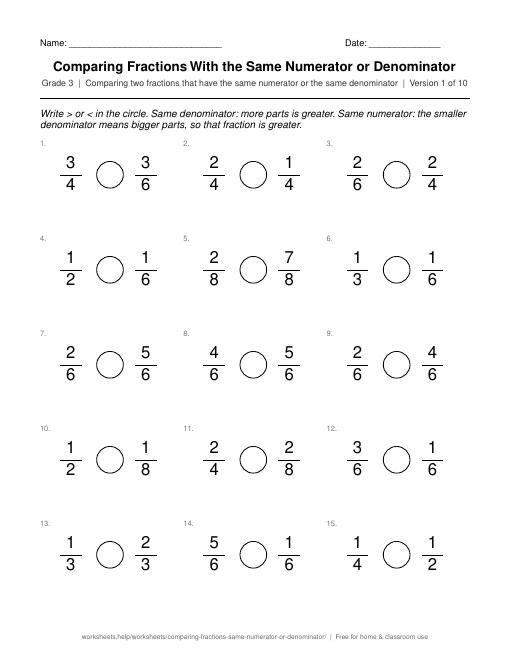
In third grade, children compare fractions by thinking about the size and number of the parts, without finding a common denominator. This third-grade worksheet gives fifteen comparisons, and every pair has either the same denominator or the same numerator.
When the denominators match, such as 3/8 and 5/8, the parts are the same size, so the fraction with more parts is greater. When the numerators match, such as 2/3 and 2/6, there are the same number of parts, but thirds are bigger than sixths, so 2/3 is greater. That second idea surprises many children, who expect a bigger denominator to mean a bigger fraction. Each page mixes eight same-denominator pairs with seven same-numerator pairs, and children write > or < in the circle between the fractions. The denominators are 2, 3, 4, 6, and 8, the ones third graders use. Across the ten versions, every possible pair appears before any pair repeats.
How to use it: draw two bars the same length and split them into the parts named by each denominator. Shading the fractions makes the comparison easy to see. A pizza or a chocolate bar also works: would you rather have one slice of a pizza cut into 3 or one slice of a pizza cut into 6? Remind your child that the two fractions must come from wholes of the same size.
The answer key shows every symbol. For more practice, try our Identify Fractions With Shapes worksheet and our Fractions on a Number Line worksheet. For different denominators, try our Comparing Fractions With Different Denominators worksheet.