Comparing Fractions With Different Denominators
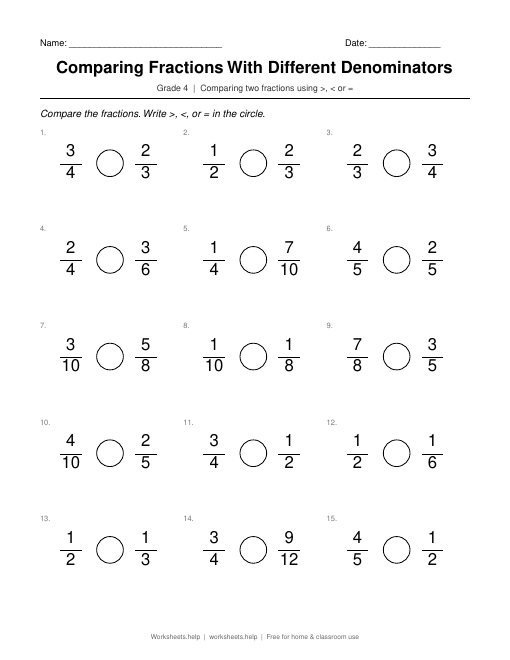
Skill: Comparing two fractions using >, < or =
Download PDF worksheetAnswer key (PDF)
Free for personal and classroom use. Print at 100% / "Actual size" on US Letter paper.
About this worksheet
Which is bigger, 3/4 or 2/3? This fourth-grade worksheet gives students fifteen pairs of fractions to compare, writing >, <, or = in the circle between them. The fractions use the denominators emphasized in grade 4: 2, 3, 4, 5, 6, 8, 10, and 12. Most pairs have different numerators and different denominators, and a few pairs are equivalent, so students cannot assume there is always a bigger fraction.
Comparing fractions is tricky because the bigger denominator does not mean the bigger fraction. In fact, 1/8 is smaller than 1/2, because the whole is split into more, smaller pieces. Students need strategies that work every time.
How to use it: show students three strategies and let them choose. First, find a common denominator: rewrite 3/4 and 2/3 as 9/12 and 8/12, then compare numerators. Second, compare to a benchmark like 1/2: since 3/10 is less than half and 5/8 is more than half, 3/10 is smaller. Third, use same-size pieces: if two fractions have the same numerator, the one with the smaller denominator is larger. Fraction strips or drawn bars of the same length help students check their thinking visually.
The answer key shows the correct symbol for each pair. This worksheet supports Common Core standard 4.NF.A.2 (compare two fractions with different numerators and different denominators by creating common denominators or numerators, or by comparing to a benchmark fraction such as 1/2, and record the results with >, =, or <).
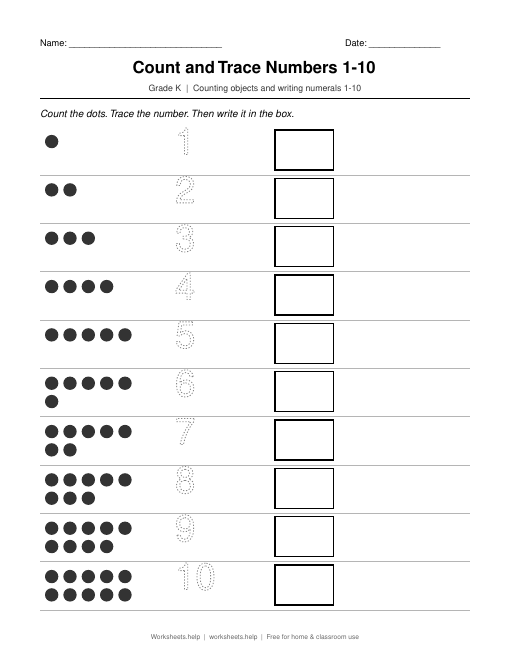 Count and Trace Numbers 1-10
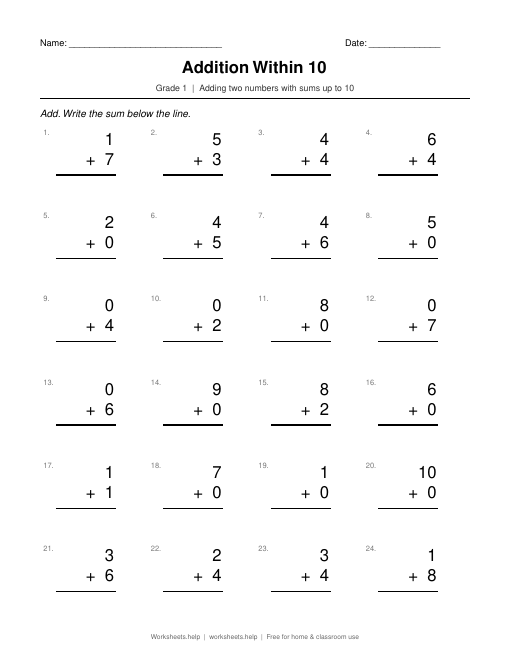 Addition Within 10
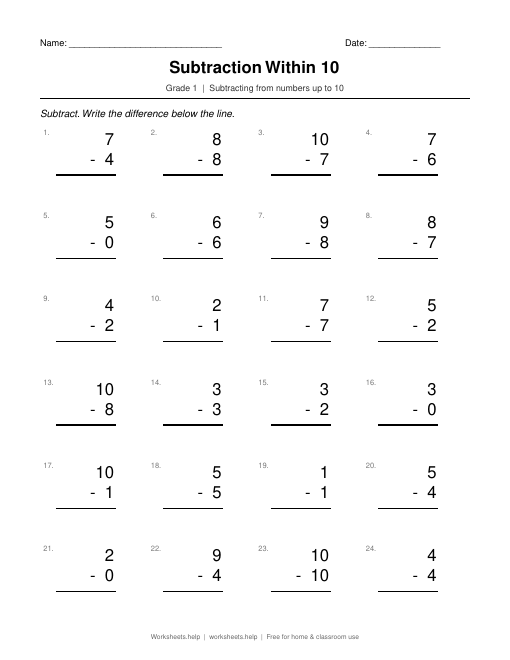 Subtraction Within 10