Writing Numerical Expressions Worksheets for 5th Grade
Download PDF worksheetAnswer key (PDF)Worksheet + answer key (2 pages)
Prints on one US Letter page; the answer key is a separate page. Print at 100% / "Actual size" on US Letter paper. Free for personal and classroom use. Version 1 of 10. Choose another version.
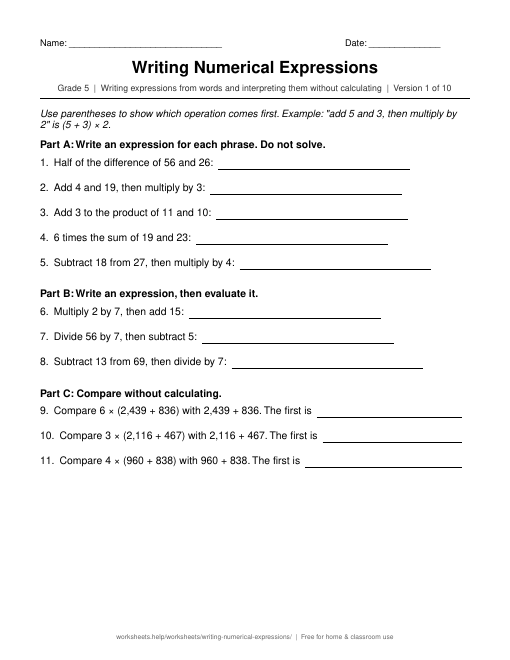
Skill: Writing expressions from words and interpreting them without calculating
Teaching tips and what to try next
Turning words into expressions ("add 8 and 7, then multiply by 2" is 2 x (8 + 7)) is the start of algebra. Ask your child to describe an expression without calculating: 3 x (18 + 932) is three times as large as 18 + 932. Next, try Order of Operations With Parentheses and Brackets or Order of Operations With Parentheses, Brackets and Braces.
10 versions, each with its own answer key
Same skill and layout, a fresh set of problems in every version, so children can keep practicing without repeating a page. Problems are not repeated between versions unless a skill has only a small number of possible problems (for example, the addition facts within 10).
- Version 1: Sheet · Key · Both
- Version 2: Sheet · Key · Both
- Version 3: Sheet · Key · Both
- Version 4: Sheet · Key · Both
- Version 5: Sheet · Key · Both
- Version 6: Sheet · Key · Both
- Version 7: Sheet · Key · Both
- Version 8: Sheet · Key · Both
- Version 9: Sheet · Key · Both
- Version 10: Sheet · Key · Both
Download all 10 versions (one PDF)All 10 answer keys (PDF)
Make a new one
Want more practice? Make a brand-new Writing Numerical Expressions sheet with fresh problems and its matching answer key, created right in your browser.
Related worksheets


About this worksheet
This fifth grade worksheet turns words into math. In Part A, children write an expression for phrases such as "add 4 and 19, then multiply by 3" without solving it. In Part B, they write the expression and then evaluate it. In Part C, they compare expressions without calculating. For example, 4 x (1,234 + 567) is 4 times as large as 1,234 + 567, because it is the same sum multiplied by 4.
The phrases include "the sum of," "the product of," "the difference of," "half of" and "then," so children practice deciding where parentheses belong. Each of the 10 versions has new phrases and numbers.
How to use it: have your child underline the operation that happens first in each phrase. That part usually goes in parentheses. Read the finished expression back in words to check that it matches. For Part C, cover the big numbers with a sticky note and ask, "What is happening to this amount?" Children who see the structure do not need to calculate at all.
The answer key shows each expression and value. For more practice, try our Order of Operations With Parentheses, Brackets and Braces worksheet.