Word Problems With Three Numbers Worksheets for 1st Grade
Download PDF worksheetAnswer key (PDF)Worksheet + answer key (2 pages)
Prints on one US Letter page; the answer key is a separate page. Print at 100% / "Actual size" on US Letter paper. Free for personal and classroom use. Version 1 of 10. Choose another version.
Skill: Solving addition word problems with three numbers and a total up to 20
Teaching tips and what to try next
Right for first graders who already add two numbers within 20 and can read short sentences with a little help. Acting out one story with small toys, putting each group down as you read it, shows that the order of adding does not matter. For bare numbers, use Adding Three Numbers; for stories with bigger numbers later, see Addition and Subtraction Word Problems Within 100.
10 versions, each with its own answer key
Same skill and layout, a fresh set of problems in every version, so children can keep practicing without repeating a page. Problems are not repeated between versions unless a skill has only a small number of possible problems (for example, the addition facts within 10).
- Version 1: Sheet · Key · Both
- Version 2: Sheet · Key · Both
- Version 3: Sheet · Key · Both
- Version 4: Sheet · Key · Both
- Version 5: Sheet · Key · Both
- Version 6: Sheet · Key · Both
- Version 7: Sheet · Key · Both
- Version 8: Sheet · Key · Both
- Version 9: Sheet · Key · Both
- Version 10: Sheet · Key · Both
Download all 10 versions (one PDF)All 10 answer keys (PDF)
Make a new one
Want more practice? Make a brand-new Word Problems With Three Numbers sheet with fresh problems and its matching answer key, created right in your browser.
Related worksheets
About this worksheet
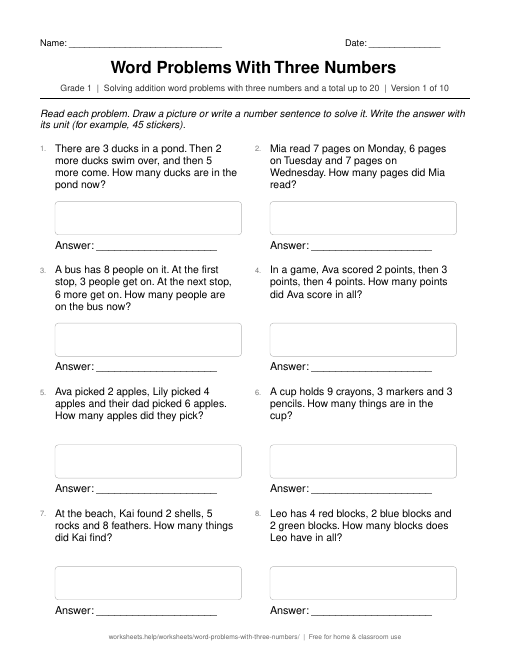
First graders are expected to solve word problems that ask them to add three numbers with a total up to 20. These problems ask children to keep track of three amounts at once, which builds careful reading as well as adding. This first-grade worksheet gives eight short stories, each with three numbers to add.
The stories use everyday scenes: blocks in three colors, ducks swimming over to a pond, pages read on three days, apples picked by a family, people getting on a bus, things found at the beach, crayons and markers in a cup, and points scored in a game. Every number in a story is from 2 to 9, and the total is never more than 20. Under each story there is a box for a drawing or a number sentence and a line for the answer, which should include a word such as ducks or pages. Each of the ten versions has new numbers and names and its own answer key.
How to use it: read each story aloud the first time, and ask your child to hold up a finger for each number they hear. Encourage your child to look for two numbers that make 10, or a double, and add those first, since that makes the last step easier. If the answer is off, ask your child to point to where each number came from in the story.
The answer key shows each total with its unit. To add three numbers without a story, try our Adding Three Numbers worksheet. For stories with smaller numbers, try our Addition and Subtraction Word Problems Within 10 worksheet.