Ways to Make Numbers to 10 Worksheets for Kindergarten
Home › Kindergarten › Math
Download PDF worksheetAnswer key (PDF)Worksheet + answer key (2 pages)
Prints on one US Letter page; the answer key is a separate page. Print at 100% / "Actual size" on US Letter paper. Free for personal and classroom use. Version 1 of 10. Choose another version.
Skill: Finding different pairs of numbers that make the same total, up to 10
Teaching tips and what to try next
Fits kindergartners who can count a group to 10 and have split small sets into two parts with real objects. Children often stop after one pair, so praise the search for a new split rather than speed. Single bonds are in Number Bonds to 5 and Number Bonds to 10, and the written form with larger totals is in Missing Addends Within 10.
10 versions, each with its own answer key
Same skill and layout, a fresh set of problems in every version, so children can keep practicing without repeating a page. Problems are not repeated between versions unless a skill has only a small number of possible problems (for example, the addition facts within 10).
- Version 1: Sheet · Key · Both
- Version 2: Sheet · Key · Both
- Version 3: Sheet · Key · Both
- Version 4: Sheet · Key · Both
- Version 5: Sheet · Key · Both
- Version 6: Sheet · Key · Both
- Version 7: Sheet · Key · Both
- Version 8: Sheet · Key · Both
- Version 9: Sheet · Key · Both
- Version 10: Sheet · Key · Both
Download all 10 versions (one PDF)All 10 answer keys (PDF)
Make a new one
Want more practice? Make a brand-new Ways to Make Numbers to 10 sheet with fresh problems and its matching answer key, created right in your browser.
Related worksheets
About this worksheet
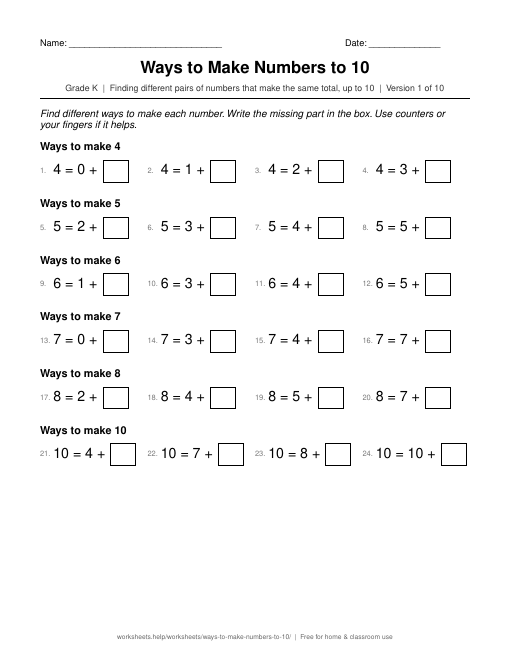
There is more than one way to make a number. Seven can be 3 and 4, or 5 and 2, or even 7 and 0. Kindergartners are expected to break numbers up to 10 into pairs in more than one way, and this kindergarten worksheet asks children to find several pairs for the same total, one after another.
The page has six target numbers chosen from 4 to 10, listed from smallest to largest. Each target has its own row of four equations, such as 7 = 2 + [ ], and children write the missing part in the box. The first part grows from left to right in every row, so children can notice that when one part gets bigger, the other part gets smaller. Some equations may use a zero, such as 6 = 0 + 6, which is a fair way to make a number too. Each of the ten versions uses a new mix of targets and pairs and has its own answer key.
How to use it: give your child the target number of small objects, such as buttons or blocks, and two cups. Move objects from one cup to the other and say each new pair out loud before writing it. Fingers work too: hold up the target number and fold some down to find the other part.
The answer key shows every missing part. For one pair at a time in a bond picture, try our Number Bonds to 10 worksheet. For smaller totals, try our Number Bonds to 5 worksheet. For the same idea with bigger numbers, try our Missing Addends Within 10 worksheet.