Regrouping Tens and Ones Worksheets for 1st Grade
Download PDF worksheetAnswer key (PDF)Worksheet + answer key (2 pages)
Prints on one US Letter page; the answer key is a separate page. Print at 100% / "Actual size" on US Letter paper. Free for personal and classroom use. Version 1 of 10. Choose another version.
Skill: Trading 10 ones for a ten and breaking a ten into 10 ones
Teaching tips and what to try next
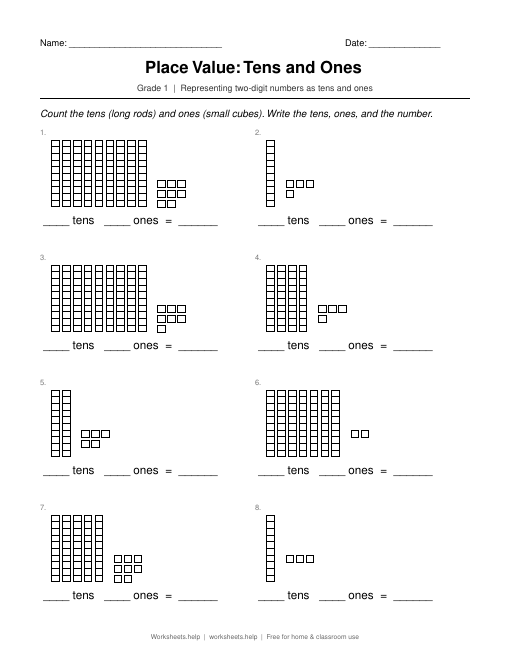
For first graders who can show two-digit numbers with rods and cubes in Place Value: Tens and Ones. Keep ten loose cubes on the table so your child can physically swap them for a rod and back again. Writing numbers as tens plus ones is in Expanded Form With Tens and Ones, and the same trade inside subtraction appears in Two-Digit Subtraction With Regrouping.
10 versions, each with its own answer key
Same skill and layout, a fresh set of problems in every version, so children can keep practicing without repeating a page. Problems are not repeated between versions unless a skill has only a small number of possible problems (for example, the addition facts within 10).
- Version 1: Sheet · Key · Both
- Version 2: Sheet · Key · Both
- Version 3: Sheet · Key · Both
- Version 4: Sheet · Key · Both
- Version 5: Sheet · Key · Both
- Version 6: Sheet · Key · Both
- Version 7: Sheet · Key · Both
- Version 8: Sheet · Key · Both
- Version 9: Sheet · Key · Both
- Version 10: Sheet · Key · Both
Download all 10 versions (one PDF)All 10 answer keys (PDF)
Make a new one
Want more practice? Make a brand-new Regrouping Tens and Ones sheet with fresh problems and its matching answer key, created right in your browser.
Related worksheets
About this worksheet
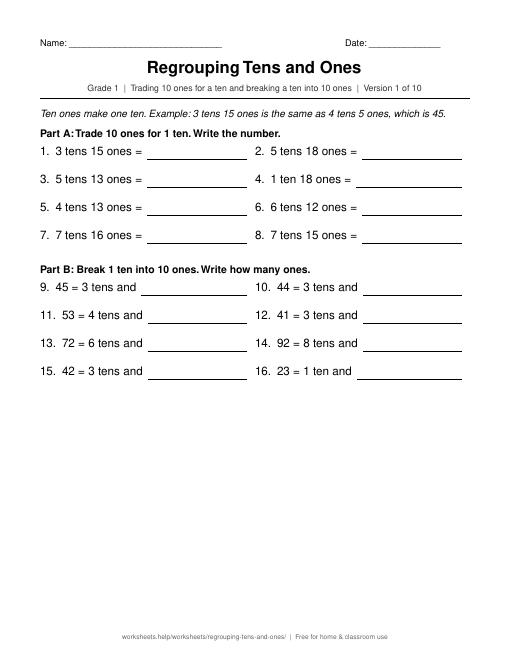
Ten ones and one ten are the same amount, and children who truly understand that can trade back and forth between them. A number such as 45 can be 4 tens and 5 ones, but it can also be 3 tens and 15 ones. First graders are expected to understand a ten as a bundle of ten ones, and this first grade worksheet practices both directions of the trade.
The page has two parts. Part A has eight problems such as 3 tens 15 ones, where there are more than nine ones. Children make a new ten out of ten of the ones and write the number, so 3 tens 15 ones is 45. Part B has eight problems that start with a two-digit number and one fewer ten, such as 52 = 4 tens and ___, and children write how many ones are needed. Every number is 99 or less. Each of the ten versions has new numbers and its own answer key.
How to use it: build a few problems with base-ten blocks, bundles of straws, or groups of ten drawn as sticks. In Part A, have your child circle ten loose ones and turn them into a stick. In Part B, draw one stick as ten dots instead. A common mistake in Part B is writing only the ones digit, so ask how many ones there are after the ten is broken.
The answer key shows every number and every count of ones. For writing numbers as tens and ones, try our Place Value: Tens and Ones worksheet. For using the trade in a calculation, try our Two-Digit Subtraction With Regrouping worksheet.