Reading Picture Graphs With a Key Worksheets for 3rd Grade
Download PDF worksheetAnswer key (PDF)Worksheet + answer key (2 pages)
Prints on one US Letter page; the answer key is a separate page. Print at 100% / "Actual size" on US Letter paper. Free for personal and classroom use. Version 1 of 10. Choose another version.
Skill: Reading scaled picture graphs and solving one- and two-step problems
Teaching tips and what to try next
Ready for third graders who skip count by 2s, 5s and 10s and can read the simpler graphs in Reading Bar Graphs. Writing the total at the end of each row before answering turns the graph into a list of numbers, which prevents most mistakes. Afterward, practice addition and subtraction stories with similar numbers in Two-Step Word Problems.
10 versions, each with its own answer key
Same skill and layout, a fresh set of problems in every version, so children can keep practicing without repeating a page. Problems are not repeated between versions unless a skill has only a small number of possible problems (for example, the addition facts within 10).
- Version 1: Sheet · Key · Both
- Version 2: Sheet · Key · Both
- Version 3: Sheet · Key · Both
- Version 4: Sheet · Key · Both
- Version 5: Sheet · Key · Both
- Version 6: Sheet · Key · Both
- Version 7: Sheet · Key · Both
- Version 8: Sheet · Key · Both
- Version 9: Sheet · Key · Both
- Version 10: Sheet · Key · Both
Download all 10 versions (one PDF)All 10 answer keys (PDF)
Make a new one
Want more practice? Make a brand-new Reading Picture Graphs With a Key sheet with fresh problems and its matching answer key, created right in your browser.
Related worksheets
About this worksheet
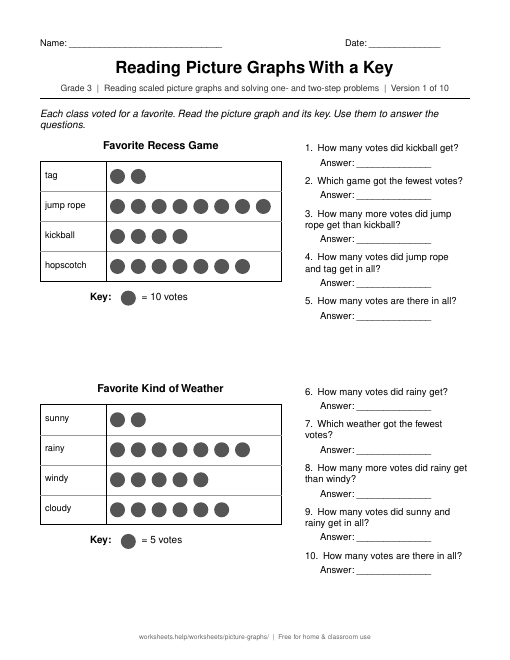
In third grade, picture graphs get a key, and each picture can stand for more than one thing. A child who counts five circles and answers "5" has missed that each circle means 2, 5, or 10 votes. This third-grade worksheet gives two picture graphs to read, each with five questions.
Each graph shows how a class voted on a topic such as favorite pets, ways to get to school, or favorite recess games. There are four choices with one to eight circles each, and a key below the graph tells how many votes one circle stands for. The two graphs on a page always use different keys, so children must read the key every time. The questions ask how many votes one choice got, which choice got the most or fewest votes, how many more votes one choice got than another, how many two choices got together, and how many votes there were in all. Each of the ten versions has new graphs and its own answer key.
How to use it: before answering, have your child read the key out loud and write the value next to each row, counting by 2s, 5s, or 10s. That turns every row into a number and makes the comparison and total questions much easier. For "how many more" questions, encourage your child to subtract, or to count up from the smaller number. Afterward, take a quick family vote and make your own picture graph with a key.
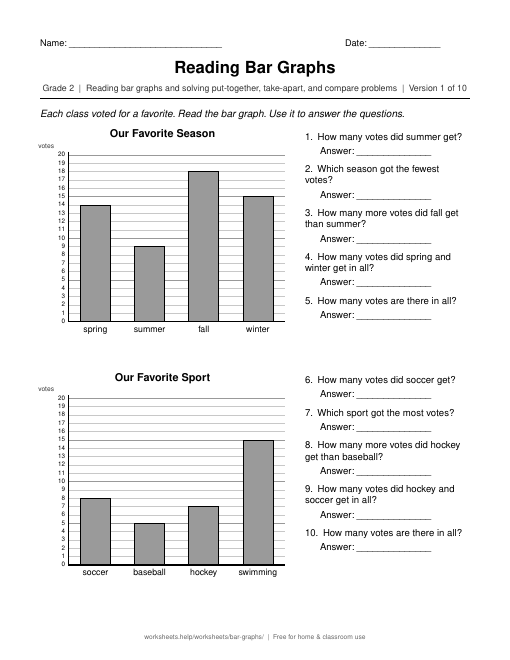
The answer key shows every answer. For graphs with bars instead of pictures, try our Reading Bar Graphs worksheet.