Past, Present and Future Verbs Worksheets for 1st Grade
Home › 1st Grade › Reading & Writing
Download PDF worksheetAnswer key (PDF)Worksheet + answer key (2 pages)
Prints on one US Letter page; the answer key is a separate page. Print at 100% / "Actual size" on US Letter paper. Free for personal and classroom use.
Skill: Choosing the verb that matches a time clue for the past, present or future
Teaching tips and what to try next
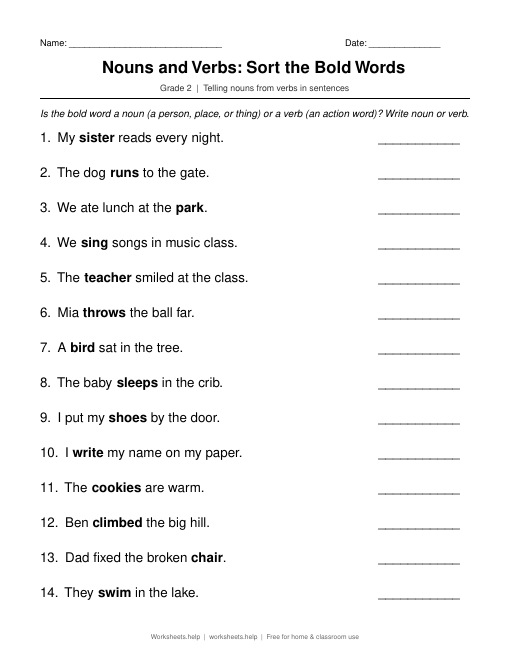
Fits first graders who can read short sentences and recognize action words. Spoken practice helps a lot: describe what you did this morning, what you are doing now and what you will do after dinner, and let your child copy the pattern. Verbs that change spelling in the past are in Irregular Past Tense Verbs, and Nouns and Verbs: Sort the Bold Words reviews which words are actions.
Related worksheets
About this worksheet
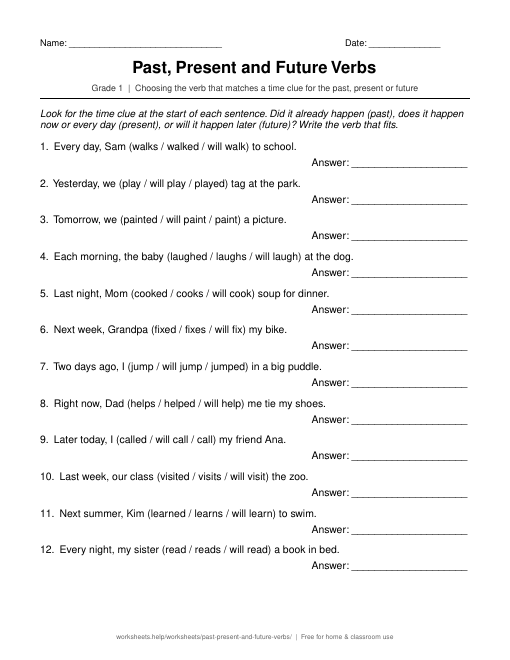
Verbs tell when something happens. Yesterday we played, every day we play, and tomorrow we will play. First graders are expected to use verbs to show past, present and future, and this first-grade grammar worksheet helps children notice the clue words that tell them which form to use.
The page has twelve sentences. Each one starts with a time clue, such as yesterday, last night, every day, right now, tomorrow or next week. In each sentence, children choose from three forms of the same verb, such as walked, walks and will walk, and write the one that fits on the answer line. There are four past sentences, four present sentences and four future sentences, mixed up on the page, and the right answer is in a different place from one sentence to the next. Every past verb on this page is a regular verb that ends in -ed.
How to use it: before your child starts, read a few time clues aloud and sort them into three groups: already happened, happens now or often, and has not happened yet. Then have your child underline the time clue in each sentence before choosing a verb. Reading the finished sentence aloud is the best check, because a wrong choice usually sounds strange. Point out that future verbs need two words, will plus the verb.
The answer key gives the verb for every sentence. For past verbs that do not end in -ed, try our Irregular Past Tense Verbs worksheet. To review action words, try our Nouns and Verbs: Sort the Bold Words worksheet.