Multiplication as Scaling Worksheets for 5th Grade
Download PDF worksheetAnswer key (PDF)Worksheet + answer key (2 pages)
Prints on one US Letter page; the answer key is a separate page. Print at 100% / "Actual size" on US Letter paper. Free for personal and classroom use. Version 1 of 10. Choose another version.
Skill: Deciding whether a product is greater than, less than or equal to a factor without multiplying
Teaching tips and what to try next
For fifth graders who can multiply a fraction by a whole number and know what an improper fraction is. A rubber band stretched along a ruler is a good picture: scaling by less than one shrinks it, by more than one stretches it. Follow up with Multiplying Fractions and Multiplying Mixed Numbers to check a few of the predictions by calculating.
10 versions, each with its own answer key
Same skill and layout, a fresh set of problems in every version, so children can keep practicing without repeating a page. Problems are not repeated between versions unless a skill has only a small number of possible problems (for example, the addition facts within 10).
- Version 1: Sheet · Key · Both
- Version 2: Sheet · Key · Both
- Version 3: Sheet · Key · Both
- Version 4: Sheet · Key · Both
- Version 5: Sheet · Key · Both
- Version 6: Sheet · Key · Both
- Version 7: Sheet · Key · Both
- Version 8: Sheet · Key · Both
- Version 9: Sheet · Key · Both
- Version 10: Sheet · Key · Both
Download all 10 versions (one PDF)All 10 answer keys (PDF)
Make a new one
Want more practice? Make a brand-new Multiplication as Scaling sheet with fresh problems and its matching answer key, created right in your browser.
Related worksheets
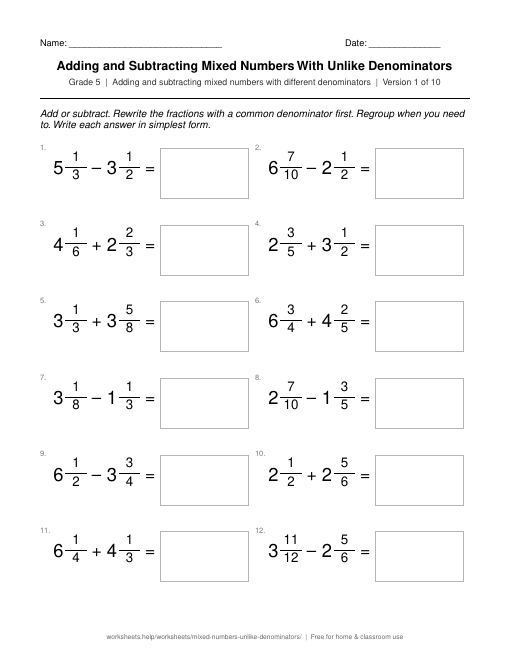 Adding and Subtracting Mixed Numbers With Unlike Denominators
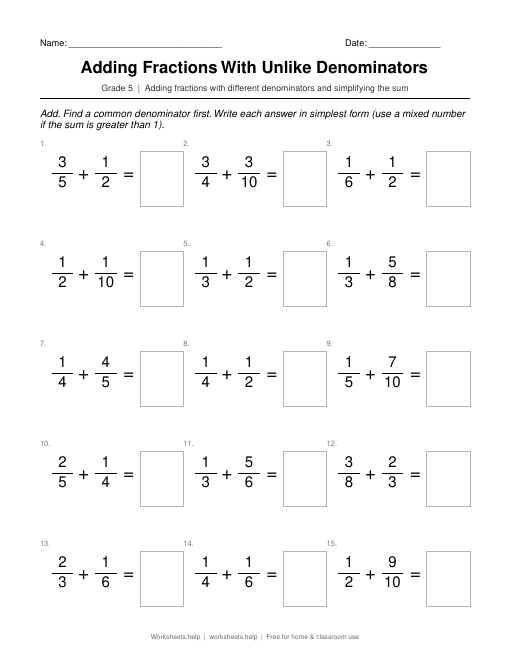 Adding Fractions With Unlike Denominators
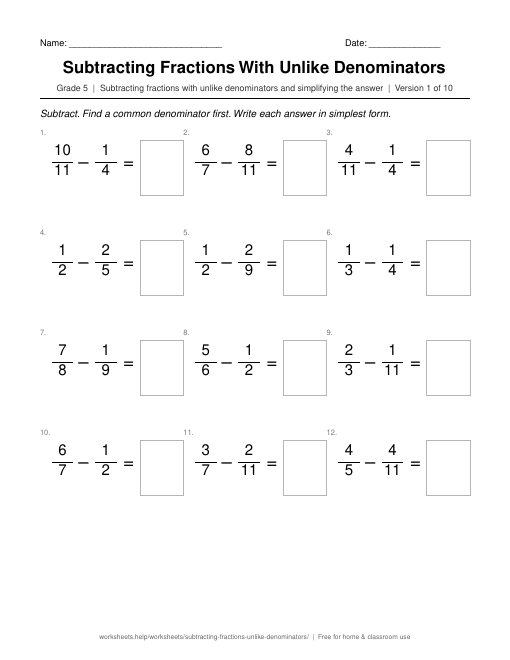 Subtracting Fractions With Unlike Denominators
About this worksheet
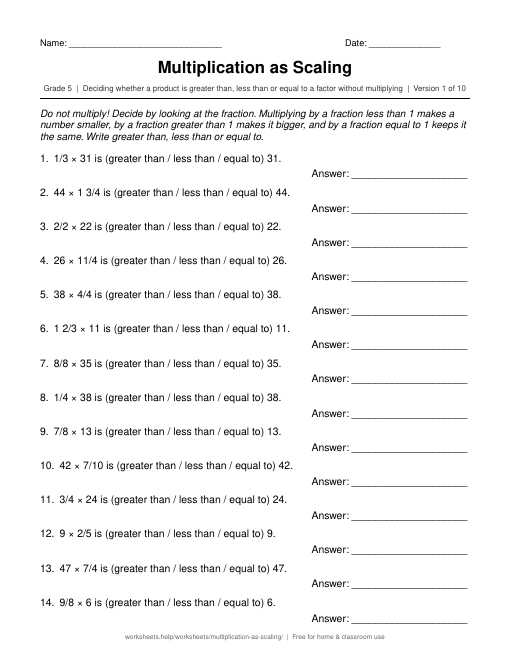
Fifth graders learn to think of multiplication as resizing, or scaling. Multiplying a number by a fraction less than 1 shrinks it, multiplying by a fraction greater than 1 makes it bigger, and multiplying by a fraction equal to 1 leaves it the same. Knowing this lets children check their answers and spot mistakes, even before they do any work. This fifth-grade worksheet practices that reasoning.
The page has fourteen items. Each one shows a whole number multiplied by a fraction, such as 3/4 × 24 or 32 × 1 2/3, and asks whether the product is greater than, less than or equal to the whole number. Six fractions are less than 1, five are greater than 1 (improper fractions or mixed numbers), and three are equal to 1, such as 6/6. The fraction is sometimes first and sometimes second, so children see that the order does not matter. Many of the products are not whole numbers, which is a reminder that the point is to reason, not to calculate. Each of the ten versions has new items and its own answer key.
How to use it: ask your child to cover the whole number and look only at the fraction. Is the top number smaller than, bigger than or equal to the bottom number? That one check gives the answer. Then try a real example: half of a 12-inch sandwich is less than 12 inches, and one and a half sandwiches is more. Children who are unsure can test a problem by working it out.
The answer key gives every answer. For practice multiplying, try our Multiplying Fractions worksheet. For mixed numbers, try our Multiplying Mixed Numbers worksheet.