Identifying 3D Shapes Worksheets for Kindergarten
Home › Kindergarten › Math
Download PDF worksheetAnswer key (PDF)Worksheet + answer key (2 pages)
Prints on one US Letter page; the answer key is a separate page. Print at 100% / "Actual size" on US Letter paper. Free for personal and classroom use. Version 1 of 10. Choose another version.
Skill: Naming cubes, cones, cylinders, spheres, and pyramids of any size
Teaching tips and what to try next
Naming solid shapes is a kindergarten geometry goal, and it comes easiest after children know the flat shapes that make up their faces. Children often call a sphere a "circle" or a cube a "square"; gently give the solid name and let them feel the difference with a real ball or block. For flat shapes, use Name the Shape: Circles, Squares, Triangles and More, and for a quick review of patterns try Shape Patterns: What Comes Next?.
10 versions, each with its own answer key
Same skill and layout, a fresh set of problems in every version, so children can keep practicing without repeating a page. Problems are not repeated between versions unless a skill has only a small number of possible problems (for example, the addition facts within 10).
- Version 1: Sheet · Key · Both
- Version 2: Sheet · Key · Both
- Version 3: Sheet · Key · Both
- Version 4: Sheet · Key · Both
- Version 5: Sheet · Key · Both
- Version 6: Sheet · Key · Both
- Version 7: Sheet · Key · Both
- Version 8: Sheet · Key · Both
- Version 9: Sheet · Key · Both
- Version 10: Sheet · Key · Both
Download all 10 versions (one PDF)All 10 answer keys (PDF)
Make a new one
Want more practice? Make a brand-new Identifying 3D Shapes sheet with fresh problems and its matching answer key, created right in your browser.
Related worksheets
About this worksheet
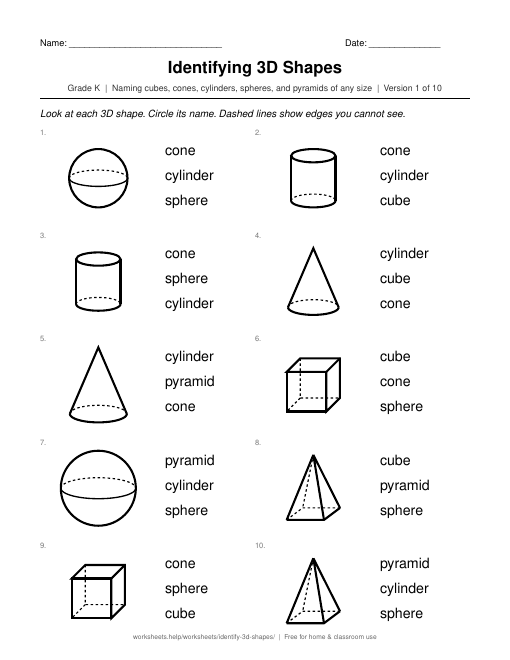
Kindergartners learn that some shapes are flat, like a square drawn on paper, and some are solid, like a block or a ball. Solid shapes are called 3D shapes because they have length, width, and height. This kindergarten worksheet helps children name five common solids: the cube, cone, cylinder, sphere, and pyramid.
Each page shows ten line drawings, two of each shape, in a mix of sizes. Next to every drawing are three names, and children circle the right one. Dashed lines show the edges you cannot see from the front, the same way 3D shapes are drawn in math books, which helps children picture the back of the shape. The order of the shapes and the choices changes on all ten versions, so children have to look at each drawing instead of remembering a pattern.
How to use it: before starting, go on a shape hunt around the house. A dice or a box is a cube, a party hat or an ice cream cone is a cone, a can of soup is a cylinder, and a ball is a sphere. Let your child hold each object while you name it, and talk about what makes it special: a sphere has no flat faces and rolls in every direction, a cylinder has two flat circles, and a cone has one circle and a point. Then compare: a square is flat, but a cube has six square faces.
The answer key circles every correct name. For flat shapes, try our Name the Shape: Circles, Squares, Triangles and More worksheet.