Comparison Word Problems Worksheets for 1st Grade: How Many More?
Download PDF worksheetAnswer key (PDF)Worksheet + answer key (2 pages)
Prints on one US Letter page; the answer key is a separate page. Print at 100% / "Actual size" on US Letter paper. Free for personal and classroom use. Version 1 of 10. Choose another version.
Skill: Solving how many more and how many fewer word problems within 20
Teaching tips and what to try next
Fits first graders who already solve simple add and take-away stories and are ready for the language of comparing. Lining up two rows of cereal pieces side by side, one for each amount, lets your child see the extra pieces instead of guessing whether to add. After this page, review the standard at 1.OA.A.1 or compare two-digit numbers in Comparing Two-Digit Numbers (>, <, =).
10 versions, each with its own answer key
Same skill and layout, a fresh set of problems in every version, so children can keep practicing without repeating a page. Problems are not repeated between versions unless a skill has only a small number of possible problems (for example, the addition facts within 10).
- Version 1: Sheet · Key · Both
- Version 2: Sheet · Key · Both
- Version 3: Sheet · Key · Both
- Version 4: Sheet · Key · Both
- Version 5: Sheet · Key · Both
- Version 6: Sheet · Key · Both
- Version 7: Sheet · Key · Both
- Version 8: Sheet · Key · Both
- Version 9: Sheet · Key · Both
- Version 10: Sheet · Key · Both
Download all 10 versions (one PDF)All 10 answer keys (PDF)
Make a new one
Want more practice? Make a brand-new Comparison Word Problems: How Many More? sheet with fresh problems and its matching answer key, created right in your browser.
Related worksheets
About this worksheet
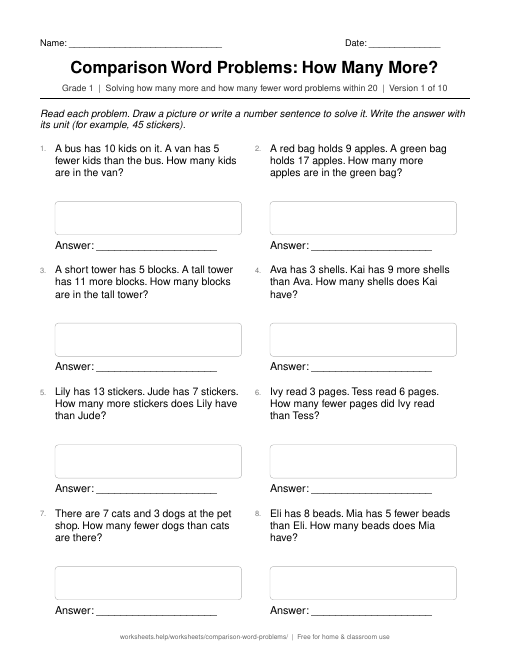
Comparison problems are often the trickiest word problems for first graders. A question like "How many more stickers does Ava have than Leo?" asks for a difference, not a total, even though it uses the word more. This first-grade worksheet gives eight comparison stories within 20 so children can practice reading them carefully.
There are three kinds of stories. Four ask how many more or how many fewer, so children find the difference between two amounts. Two tell how many one person has and how many more someone else has, and ask for the larger amount. Two tell how many one person has and how many fewer someone else has, and ask for the smaller amount. The numbers are from 2 to 20. Under each story is a box for a drawing and a line for the answer with its unit. Each of the ten versions has new numbers and names and its own answer key.
How to use it: comparison stories make the most sense with two rows of objects lined up one to one. Put out a row of counters for each amount, match them up, and count the extras in the longer row. That count is how many more, and also how many fewer. Watch for the habit of adding every pair of numbers in a story. When your child sees the word more, ask, "More than what?" before deciding to add or subtract.
The answer key gives every answer with its unit. For take-away stories, try our Subtraction Word Problems Within 20 worksheet. For add-to stories, try our Addition Word Problems Within 20 worksheet.