Classifying Triangles by Sides and Angles Worksheets for 4th Grade
Download PDF worksheetAnswer key (PDF)Worksheet + answer key (2 pages)
Prints on one US Letter page; the answer key is a separate page. Print at 100% / "Actual size" on US Letter paper. Free for personal and classroom use. Version 1 of 10. Choose another version.
Skill: Classifying triangles as acute, right or obtuse and as equilateral, isosceles or scalene
Teaching tips and what to try next
Aimed at fourth graders who can already sort single angles in Classify Angles: Acute, Right or Obtuse. A folded square corner helps test for a right angle before naming the triangle. Side classification needs careful reading of the three lengths, and lines and rays are reviewed in Lines, Rays and Line Segments.
10 versions, each with its own answer key
Same skill and layout, a fresh set of problems in every version, so children can keep practicing without repeating a page. Problems are not repeated between versions unless a skill has only a small number of possible problems (for example, the addition facts within 10).
- Version 1: Sheet · Key · Both
- Version 2: Sheet · Key · Both
- Version 3: Sheet · Key · Both
- Version 4: Sheet · Key · Both
- Version 5: Sheet · Key · Both
- Version 6: Sheet · Key · Both
- Version 7: Sheet · Key · Both
- Version 8: Sheet · Key · Both
- Version 9: Sheet · Key · Both
- Version 10: Sheet · Key · Both
Download all 10 versions (one PDF)All 10 answer keys (PDF)
Make a new one
Want more practice? Make a brand-new Classifying Triangles by Sides and Angles sheet with fresh problems and its matching answer key, created right in your browser.
Related worksheets
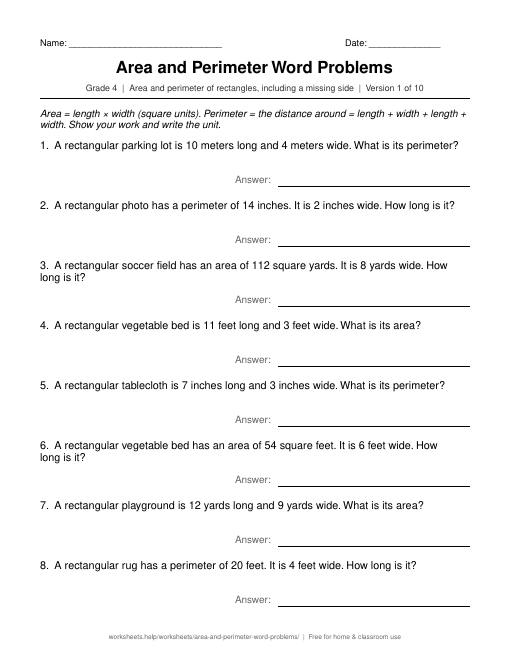 Area and Perimeter Word Problems
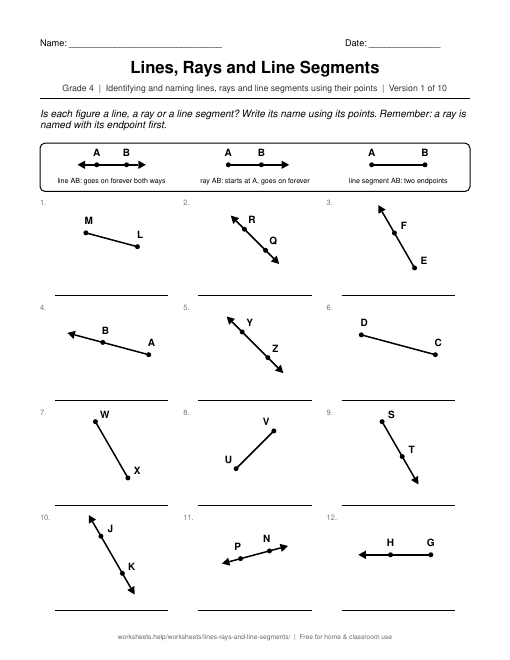 Lines, Rays and Line Segments
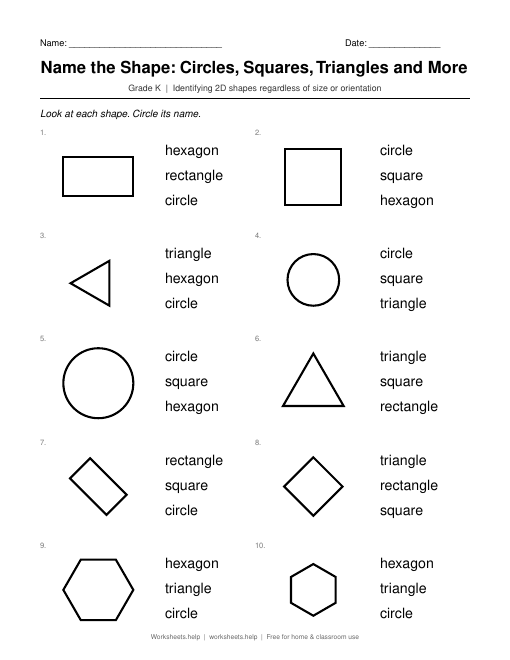 Name the Shape: Circles, Squares, Triangles and More
About this worksheet
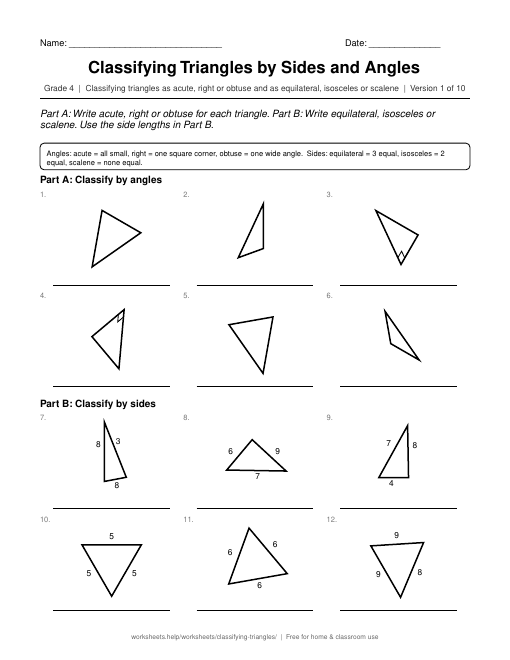
Triangles can be sorted in two useful ways: by their angles and by their sides. An acute triangle has three acute angles, a right triangle has one right angle, and an obtuse triangle has one obtuse angle. By sides, a triangle may be equilateral, isosceles or scalene. Fourth graders are expected to classify figures by angles and related properties, and this fourth grade worksheet practices both sorts.
The page has twelve triangles. In Part A, six triangles ask children to write acute, right or obtuse from the shape of the angles. In Part B, six triangles show side lengths, and children write equilateral, isosceles or scalene. A short reminder at the top reviews the six words. Each of the ten versions has new triangles and its own answer key.
How to use it: for Part A, have your child compare each angle to a square corner made with a folded piece of paper. For Part B, read the three side lengths out loud and ask how many match. A right isosceles triangle can appear in either part depending on what the question asks, so reading the direction matters.
The answer key names every triangle. For sorting single angles first, try our Classify Angles: Acute, Right or Obtuse worksheet. For the building blocks of geometry, try our Lines, Rays and Line Segments worksheet.