Area of Rectangles by Multiplying Worksheets for 3rd Grade
Download PDF worksheetAnswer key (PDF)Worksheet + answer key (2 pages)
Prints on one US Letter page; the answer key is a separate page. Print at 100% / "Actual size" on US Letter paper. Free for personal and classroom use. Version 1 of 10. Choose another version.
Skill: Finding the area of a rectangle by multiplying its length and width
Teaching tips and what to try next
Meant for third graders who have counted unit squares and know their basic multiplication facts. Mixing up area and perimeter is common, so ask whether the question is about covering the inside or walking around the edge. Count squares first in Area of Rectangles on a Grid, compare with Perimeter of Polygons, and see the standard summary at 3.MD.C.7.
10 versions, each with its own answer key
Same skill and layout, a fresh set of problems in every version, so children can keep practicing without repeating a page. Problems are not repeated between versions unless a skill has only a small number of possible problems (for example, the addition facts within 10).
- Version 1: Sheet · Key · Both
- Version 2: Sheet · Key · Both
- Version 3: Sheet · Key · Both
- Version 4: Sheet · Key · Both
- Version 5: Sheet · Key · Both
- Version 6: Sheet · Key · Both
- Version 7: Sheet · Key · Both
- Version 8: Sheet · Key · Both
- Version 9: Sheet · Key · Both
- Version 10: Sheet · Key · Both
Download all 10 versions (one PDF)All 10 answer keys (PDF)
Make a new one
Want more practice? Make a brand-new Area of Rectangles by Multiplying sheet with fresh problems and its matching answer key, created right in your browser.
Related worksheets
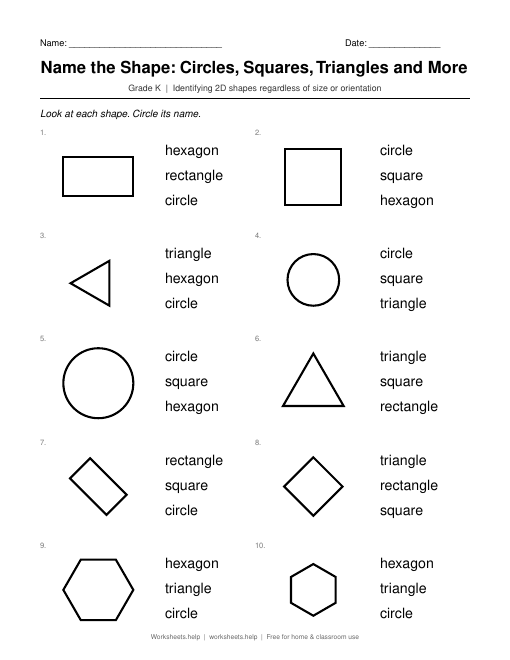 Name the Shape: Circles, Squares, Triangles and More
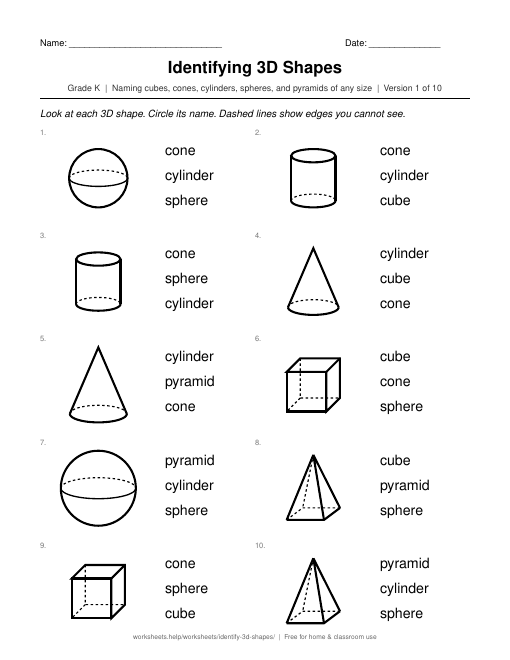 Identifying 3D Shapes
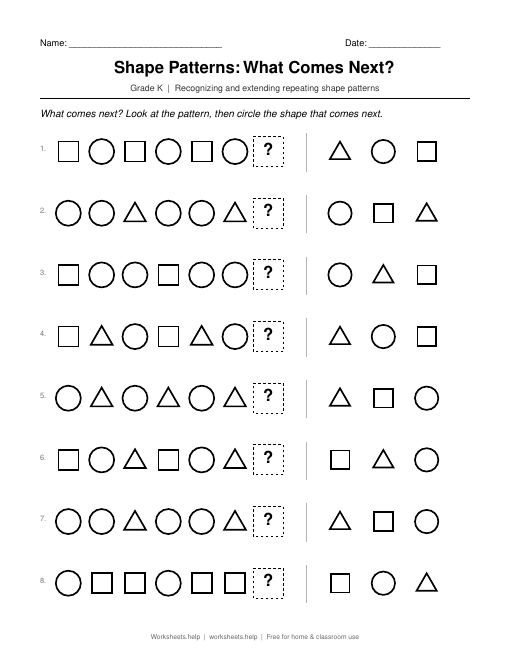 Shape Patterns: What Comes Next?
About this worksheet
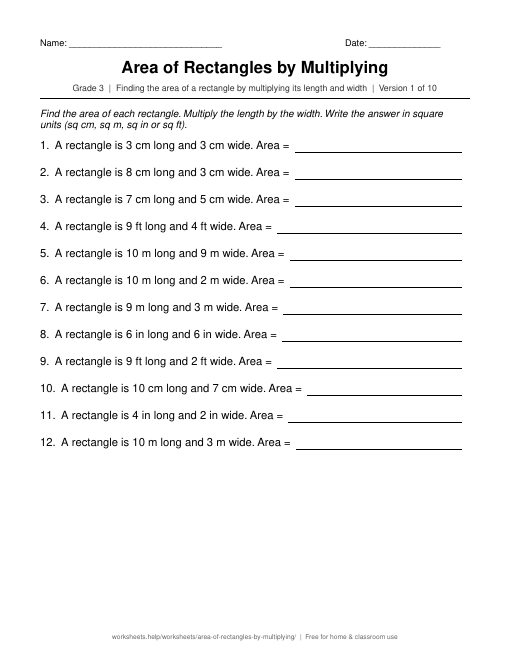
Once children have counted square units on a grid, they are ready for a shortcut. A rectangle that is 6 units long and 4 units wide has 4 rows of 6 squares, so its area is 6 times 4, or 24 square units. Third graders are expected to multiply side lengths to find the area of rectangles with whole-number sides, and this third grade worksheet practices that step without a grid.
The page has twelve short problems. Each one gives the length and width of a rectangle in centimeters, meters, inches or feet. Children multiply the two side lengths and write the area with square units, such as 24 sq cm or 18 sq ft. Lengths go from 3 to 10 and widths from 2 to 9, so every product is a basic multiplication fact. Some rectangles may be squares, with the same length and width. Each of the ten versions has new rectangles and its own answer key.
How to use it: before starting, have your child sketch one rectangle on grid paper and count the squares, then multiply to see that both ways give the same number. Remind them that area is always written in square units, so an answer of just 24 is not finished. If a fact is slow, a multiplication chart can sit nearby for the first few problems.
The answer key shows every area with its unit. For counting squares first, try our Area of Rectangles on a Grid worksheet. For the distance around a shape instead, try our Perimeter of Polygons worksheet.