Estimating Sums and Differences Worksheets for 3rd Grade
Download PDF worksheetAnswer key (PDF)Worksheet + answer key (2 pages)
Prints on one US Letter page; the answer key is a separate page. Print at 100% / "Actual size" on US Letter paper. Free for personal and classroom use. Version 1 of 10. Choose another version.
Skill: Rounding to the nearest 10 or 100 to estimate answers
Teaching tips and what to try next
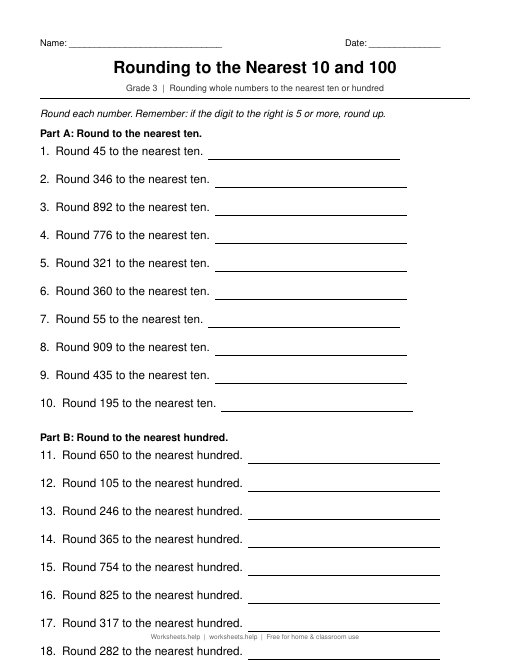
For third graders who can round on their own, as practiced in Rounding to the Nearest 10 and 100. Encourage your child to say the estimate first and only then work the exact problem, so estimating becomes a habit for checking answers. Exact practice with the same number sizes is in Mixed 3-Digit Addition and Subtraction.
10 versions, each with its own answer key
Same skill and layout, a fresh set of problems in every version, so children can keep practicing without repeating a page. Problems are not repeated between versions unless a skill has only a small number of possible problems (for example, the addition facts within 10).
- Version 1: Sheet · Key · Both
- Version 2: Sheet · Key · Both
- Version 3: Sheet · Key · Both
- Version 4: Sheet · Key · Both
- Version 5: Sheet · Key · Both
- Version 6: Sheet · Key · Both
- Version 7: Sheet · Key · Both
- Version 8: Sheet · Key · Both
- Version 9: Sheet · Key · Both
- Version 10: Sheet · Key · Both
Download all 10 versions (one PDF)All 10 answer keys (PDF)
Make a new one
Want more practice? Make a brand-new Estimating Sums and Differences sheet with fresh problems and its matching answer key, created right in your browser.
Related worksheets
About this worksheet
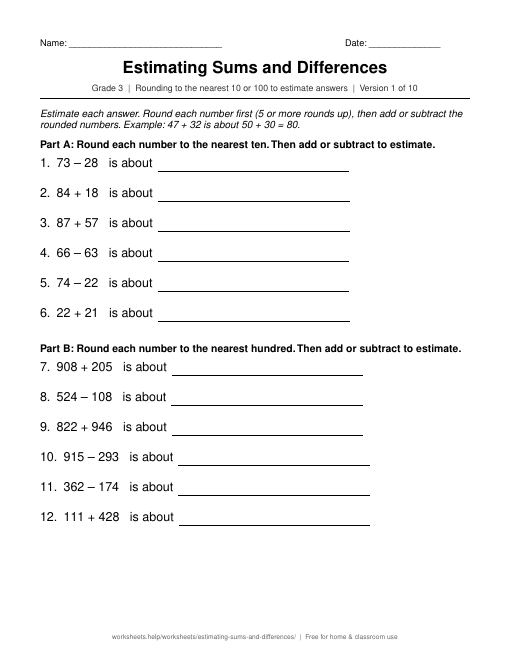
Estimating helps third graders check whether an answer makes sense. Before adding 386 + 211, a student can round to 400 + 200 and expect an answer close to 600. This third-grade worksheet practices the two steps of estimating: rounding each number, then adding or subtracting the rounded numbers.
Part A has six problems with two-digit numbers that are rounded to the nearest ten. Part B has six problems with three-digit numbers that are rounded to the nearest hundred. Each part has three addition problems and three subtraction problems in mixed order. To keep the focus on estimating, no number in Part A ends in 5, and no number in Part B has a 5 in the tens place, so there is no tie to puzzle over. Students write the rounded problem and the estimate on the line, such as 400 + 200 = 600. Each of the ten versions has new problems and its own answer key.
How to use it: remind your child to look at the digit just to the right of the place they are rounding to. If it is 5 or more, round up; if it is 4 or less, keep the digit and change the rest to zeros. A number line marked in tens or hundreds can show which friendly number is closer. Afterward, work out two exact answers together and compare them with the estimates.
The answer key shows each rounded problem and estimate. To practice rounding alone, try our Rounding to the Nearest 10 and 100 worksheet. For exact answers, try our Mixed 3-Digit Addition and Subtraction worksheet.