Counting Objects to 5 Worksheets for Kindergarten
Home › Kindergarten › Math
Download PDF worksheetAnswer key (PDF)Worksheet + answer key (2 pages)
Prints on one US Letter page; the answer key is a separate page. Print at 100% / "Actual size" on US Letter paper. Free for personal and classroom use. Version 1 of 10. Choose another version.
Skill: Counting groups of 2 to 5 objects in different arrangements
Teaching tips and what to try next
A first counting page for kindergartners who can say one, two, three, four, five in order but still skip or double-count objects. Roll a die during snack time and ask how many dots without counting; spotting small amounts at a glance grows fast with play. Next, count bigger groups in Counting Objects to 10 or practice the numerals in Count and Trace Numbers 1-10.
10 versions, each with its own answer key
Same skill and layout, a fresh set of problems in every version, so children can keep practicing without repeating a page. Problems are not repeated between versions unless a skill has only a small number of possible problems (for example, the addition facts within 10).
- Version 1: Sheet · Key · Both
- Version 2: Sheet · Key · Both
- Version 3: Sheet · Key · Both
- Version 4: Sheet · Key · Both
- Version 5: Sheet · Key · Both
- Version 6: Sheet · Key · Both
- Version 7: Sheet · Key · Both
- Version 8: Sheet · Key · Both
- Version 9: Sheet · Key · Both
- Version 10: Sheet · Key · Both
Download all 10 versions (one PDF)All 10 answer keys (PDF)
Make a new one
Want more practice? Make a brand-new Counting Objects to 5 sheet with fresh problems and its matching answer key, created right in your browser.
Related worksheets
About this worksheet
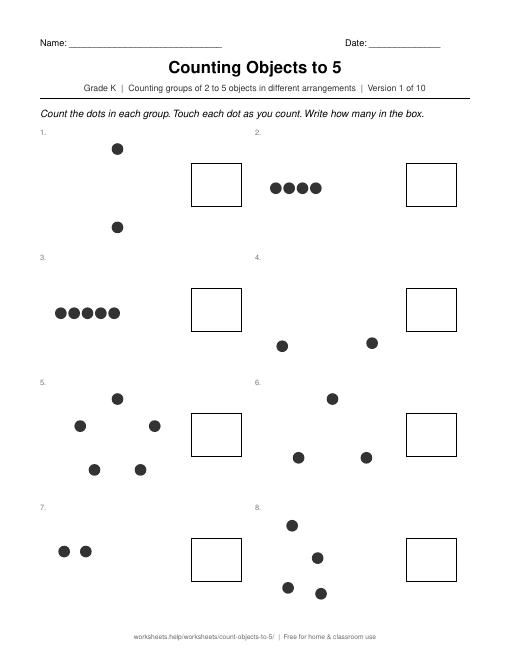
Before children can count to 10 or 20 with confidence, they need lots of success with very small groups. This kindergarten worksheet keeps every group between 2 and 5 dots, so young learners can focus on the counting habits that matter most: one number for each dot, and the last number tells how many.
The page has eight groups of dots. Some dots sit in a straight line, some in two short rows, some around a circle, and some are scattered. Children count each group and write the number in the box beside it. Because the groups are small, many children start to see the amount at a glance, which teachers call subitizing. That quick seeing is a strong base for adding and taking away later. Each of the ten versions mixes the counts and arrangements in a new way and comes with its own answer key.
How to use it: start with real objects. Put three spoons on the table, count them together, then spread them apart and ask, "How many now?" When your child moves to the page, have them touch each dot with a finger and say the numbers slowly. For the circle groups, a small pencil tick on the first dot shows where counting began. If a number is hard to write, it is fine to write it on a whiteboard first.
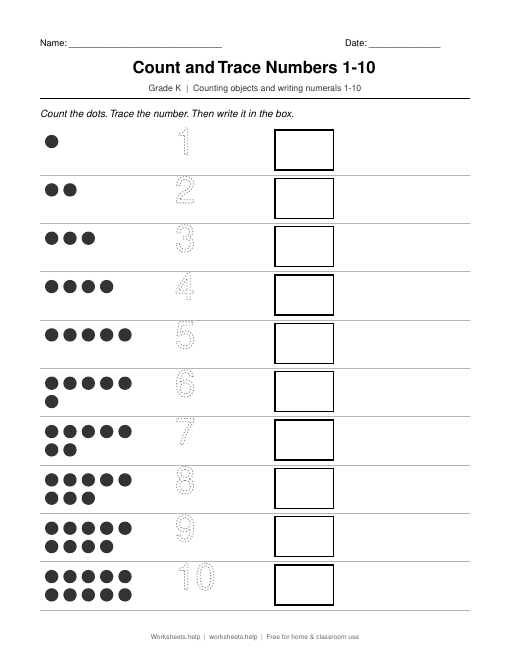
The answer key shows every count. When these feel easy, try our Counting Objects to 10 worksheet. To practice writing numerals, try our Count and Trace Numbers 1-10 worksheet.